What do I think, What can I do?

Archive for February, 2011

My journey to Germany

Last week I went to Düsseldorf and Cologne for a business trip. 3 days 4 flights, I know, several CO2 tons thrown to the atmosphere. This time I am not going to write about this, just some light and personal comments as I did in my recent trip to Rome .

As usually not totally white or black, first of all,  a news from Reuters about cuts in solar energy subsidies in Germany. It may seem discouraging as Germany is the biggest solar industry market (with less sun than many), but this news deserves a more detailed study beyond the scope of this post.

One striking photo is the next one, it was cold, not far from 0ºC, and this shop was totally open. Very attractive but very energy consuming and expensive in many senses. It would be very interesting to know our CO2 saving potential just changing this kind of evident things.
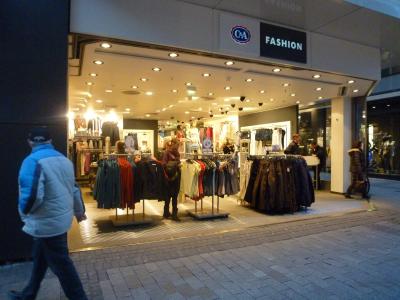
 

Completely open shop in Cologne centre's commertial area at ~0ºC

The second one is just opposite, I was really pleased to see how precise was street lights switchon time and how most of them were not too bright and directed to the floor to avoid inefficient loss in light pollution.
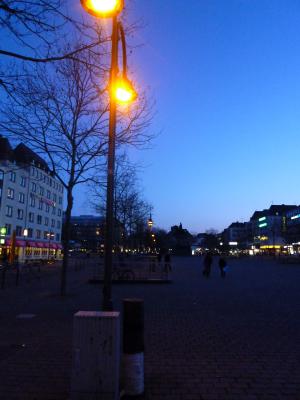
Street lamps

Street lamps switched on just when sunlight went out.

Finally one side effect of smoking ban and love for open spaces: the gas lamps in the terraces. It is growing in my home city in Bilbao too, but I saw it in central Europe before. In my personal opinion this is very similar to the open shop case, many CO2 tons thrown to the atmosphere that could easily be avoided.
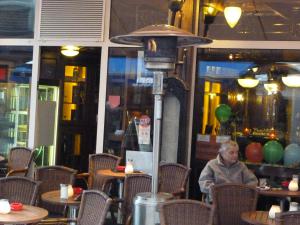
 

Open terrace with gas burner at 0-5 ºC

Another burner at 0-5 ºC, this is more spectacular


Of course, I do not intend to criticize a country that is doing much more than most. This photos could be taken in any western country. But I usually do not take the camera when I walk in Bilbao.


Light Pollution and Climate Change

It can be considered a secondary problem and certainly it is not comparable to many possible consequences of climate change as: floods, draughts, sea raising, … But, in my opinion, it is at the same time a nice and interesting symbol.

It is quite striking to realize that most prominent astronomers from XVI to XVIII centuries worked from cities. Visiting Greenwich Royal Observatory just in the outskirts of London was a real pleasure and a surprise for me.  Whereas nowadays almost everyone living in a city knows how difficult is to see any star in the night sky. In my case, the very frequently cloudy sky is another important factor too. But even for cloudless cities light pollution is a nightmare for many astronomers, and some of them are taking action against it (there are many links , those three are just a small sample: IDA, wonderful maps, Cel Fosc).  Congratulations for all of them.

Italian peninsula light pollution development, Source: http://www.lightpollution.it/

But for the moment as clearly shown in the picture we have lost hte opportunity to see the universe’s beauty. And we, urban cityzens are more than half of human population. This loss can be critizised from many point of views:

  • A phylosophycal one:the loss of perspective of the universe.
  • A scientific one: we can’t see the stars, and many amateurs find it more difficult to make contributions for general knowledge.
  • A stetical one: we are loosing a wonderful spectacle.
  • An historical one: we are getting disconnected with the night sights contemplated by our grandparents.
  • And a climate change one: We are wasting much of the light emmited by our lamps. So, we are throwing millions of tons of CO2 just to disturb astronomers, and sky lovers in general. This is an evident inefficiency and quite an interesting potential gain, we could save CO2 tons and improve this subjetive concept named quality of life.