What do I think, What can I do?

I read this post recently and found it a terrific explanation of one of the most direct and frightening consequences of climate change: sea level rise. (I also bought his book High Tide on Main Street but I will try have to read it later).

One of the figures he gives is the best summary for me: Roughly sea level raises 20 m for each ºC, based on historic data. It does not happen immediately, the huge ice sheets need time to thaw but once the temperature is fixed it is unstoppable. Considering a moderate target of 2 ºC for our future warming if we do things relatively well and stop current business as usual in a reasonable time, this would lead to a terrifying figure of 40 m sea level rise. Others sources mention basically 21st century predictions as this article ( Antonio Zecca, Luca Chiari, Global and Planetary Change.). It calculates a lower limit of 80cm this siecle and more for the next 200 years; or the NOAA, witch estimates between 20 cm and 2m.

The problem to solve in order to predict the sea level rise is very complicated. Even knowing the exact amount of water coming from Greenland or west Antarctica, or the exact temperature rise and subsequent water dilatation it would be complex as the seas are filling the land floating in the magma. So, we have to be conscious or the great error margins and the difference between coasts.

But anyway, going back to the 40 m, I think my house would be included there, some years ago, in some floods just 3 m were enough to reach the lower floor, so I will not be here to see it but it could be sad to my grandsons to say this part of the sea was our grandfathers house.

A long time before that, with much less, it is likely that some housing market will realise about that and the wonderful coastal second houses or investment values will drop sharply causing an economical and maybe financial crack, and even before the strong storms will become a great problem for inhabitants owners and insurance companies.
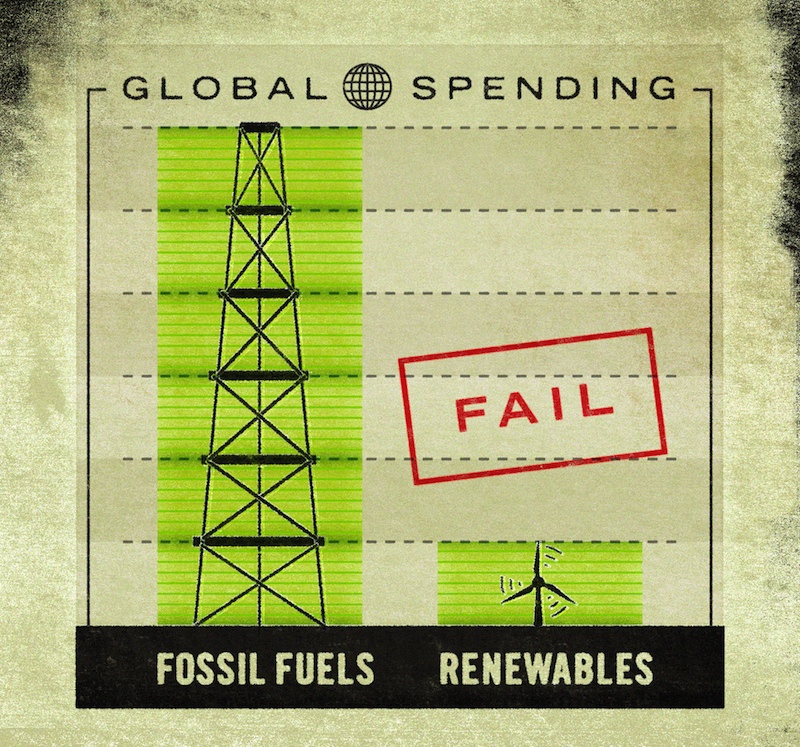
One of the most interesting campaings around Rio+20 has the goal of ending fossil fuel subsidies, as explained in Huffintongpost. It can be supported in this web . I supported it convinced of the opportunity and ethic value of this message even if I do not know very well its origin but supported by the signature of many NGOs.

Some data are really impressive, for example from climate progress  one of those cases involving $29.000 million  in carbon from public lands is denunced. Current miners strike in Spain due to a reduction of carbon subsidies is another example, although the difficult social contest in this case would require a different treatment like deviating this great amount of money to production of new sources of energy as a job source for the miners. As shown in the picture renewables are not the only ones subsidized now, and if the historical data are considered the balance goes even more to the fossil fuel side because energy has always been a state issue. This would be a question of fair bussiness in another contest, though not with climate change calling to our doors.

It is really stupid to hinder renewables expansion due to the costs whereas current mature technologies that are driving our climate mad get huge amounts of money. I really think that renewables are more expensive and that we will need sacrifice to cope with climate change; but, at least, we have to start with some minmum requirements like not subsidizing the source of the problem. This way it will be easier to measure the costs.

This nobel was nominated to last year Hugo awards and I could not read it then,  but I found another good opportunity this year as the continuation is nominated for 2012 Hugos, it is titled Deadline. I really liked both of them, more the first, even if I am not too fond of Zombie stories, in fact, I have started reading the third book in the trilogy: Blackout.
Apart from my reading tastes, in this post I wanted to note the splicit mention about global warming in the first book. The book is a distopia describing accurately and plausibly a world deeply changed due to a virus that makes dead go live again in form of hungry Zombies. This is the mayor problem in that scenario, it affects everything and have killed a lot of people from the initial raisings of 2014 (the action begins in 2039). But some other big issues of the world are mentioned in one moment and one of them is global warming. So, the author considers it a big issue even in a world severely underpopulated (for example, the whole India is left for the “infected”, and those ones live in a very low carbon style, do not use cars or lighting, or computers,…). That means that een in the case of drastic emission reduction path, Mira considers there is enough inertia to go on with climate change. It is true that in the rest of the book it is not mentioned again or noticed in another way.
In the second book, just one year later the most explicit effect of the climate is the last terrible storm, undoubtfully an extreme weather event.

In summary, two very nice science fiction books, not closely related to climate change but firmly believing in it.

My last post about this funny issue mentioned two posts earlier. In spite of the hard blogging efforts in climaterealists, may did not seem to be cold at all as explained in the mentioned post. However , just in case, I am going to use the IR temperature data from  University of Alabama in Huntsville.  Those data are compiled among others by Roy Spencer and are somehow controversial but they are accepted, adopted and  frequently used among skeptics, but they are global and are published very fast online, so they are useful for the purpose of this post.  This data source confirms not only the quite hot global temperature (fourth hottest on its records) but also the world map distribution. In effect was colder than average in some parts of Australia, in a small part of Alaska and some parts of the oceans, but it was average or hotter than average elsewhere, concretely in USA and Europe, including Britain. It was really hot in some parts of Russia. The figure below displays nicely this world map of “the coldest may”.

The question is: Considering the very low-level of autocriticism in climaterealists with this issue, and how they have just forgot it except this partially justifying post, do the rest of the contents of that blog worth a reading? It this the standard of quality or scientific rigor in skeptic blogosphere? At least in some cases it is.

Image From University of Alabama in Hunstville satellite temperature record for May 2012

Image From University of Alabama in Hunstville satellite temperature record for May 2012

This post (in Spanish) wonderfully explains the small amount of water there is in the earth compared to the size of the planet and the even tinier proportion of freshwater.

  • In fact, freshwater is less than 4% of the water in earth as 96,54% is in the oceans and seas.
  • Almost all the rest is in form of snow/ice, 1.76%, at least for the moment, and underground 1.69%
  • The lakes only hold 0.013% of the water, half freshwater, half salty. 130 ppm
  • The rivers are even more insignificant with a tiny 0.0002%, 2 ppm of the water. So, if we apply this stupid comment about the small amount of 450 ppm of CO2, we would have been lost as we depend on roughly 72 ppm of freshwater. I know this is nonsense, it is just to remember that in some cases ppms are critical.

Most dramatic consequences of climate change are related with water somehow: droughts, extreme rainfalls, floods,… Being conscious of the big figures can help us remember how delicate are water equilibria.

Sometimes the line between good and bad ones is not only subtle, it is also changing fast.

If the technology these news  explain is succesful, we may find a good ally in this gas that is transforming our climate. The concept can be explained in a simple way, they extract the heat from the earth, at 800 m below the surface and use it to produce energy. This is not new, it is the geothermal energy, the funny issue in this case is that they do it in conventional thermal power stations using the output CO2 from the combustion as the thermal conducting fluid instead of, for example, water. This way, two benefits are obtained, in one hand some carbon sequestration (I do not know how much) and  in the other additional power produced from the extracted heat.

The authors are confident with their results to the extent of making a spin-off from University and funding their own company. I have more doubts for some reasons:

  • because I do not trust much carbon sequestration,
  • because I do not understand the advantages it would have respect to other geothermal technologies and
  • because the application seems a bit limited if they have to combine a thermal power station with an appropriate geological location.

In my opinion, the main advantage would come precisely from the possibility to harness the power of standard fossil fuel installations by avoiding much of their damage (I do not how much). We will see if these good intentions make good realities or are just too optimistic or too expensive. Sometimes, when we are too tied to something it is easy to lose perspective and favour those solutions that allow us to continue with the link; I suspect this is a constant temptation for us related to fossil fuel technologies.

In any case if it works and helps I will welcome it, whereas, for the moment, I prefer to bet in the already proven wind and solar industries, among others.

Finally, it is fair to mention that my information source was amazings.com

Electricity prices are a very important issue for climate change, as the main criticism, the only serious one, towards renewable energy sources is that they are more expensive. This is a really important question much discussed in many occasions. My opinion is: yes they are more expensive at first sight but they are cheaper in the long term considering a global point of view, for example with the new richness index proposed by the UN: IWI (Inclusive Wealth Index).

Certainly, this is something I should learn and write, but in this post I prefer to focus in one example and one interview. The example is spanish situation, going from leadership in renewables to full stop in feed-in-tarif and renewable industry. It seems a bad example but I think that can help to think and learn. The last chapter of this story is the sharp increase expected in electricity prices and blaming the renewables completely about it. I am not going to it thorougtly either, I just want to mention this interview with the regulatory system responsible. He is not pro-renewables in any way and mentions them as one of the causes of the price and this incredible thing called tarif deficit (another interesting pair of words), however he explains too that prices are difficult to understand, that there are many different renewables and that too many fossil fuel power stations have also been built expecting a great economy growth and energy demand, and nowadays both are shrinking.

Blaming renewables is easy and a widespread sport but Germany has made an even greater effort and the situation is very different, so it is not so determinant the global economy health seems also important. Two final thoughts:

1.- If Spain is in a bad situation due to too much power capacity this seems an oportunity for electric mobility, it could help reduce electricity costs.

2.- Maybe more expensive electricity is not so bad, if it happened in all places. Certainly it would help efficiency and would be more realistic.

Coldest May was a repetitive title in one skeptic blog. I explained the hilarity I felt reading this by the mid or even beginning of May considering we were wearing T-shirts not so far but left for later comment the data.

Certainly the enthusiasm about this issue in climaterealists peaked in the mid of May and declined from then, as shown in next table. And there was even a slightly critics post, but not too explicit. Another confusing aspect was the geographical correspondence of the coldest may, where was it coldest? In some posts it was mentioned the UK, in others could have been the world and in the last one in June it was Australia, many choices indeed.

Date 25-30 April 1-5 May 5-10 May 10-15 May 15-20 May 20-25 May 25-30 May 0-5 June
Number of Posts 5 0 3 9 3 2 3 2

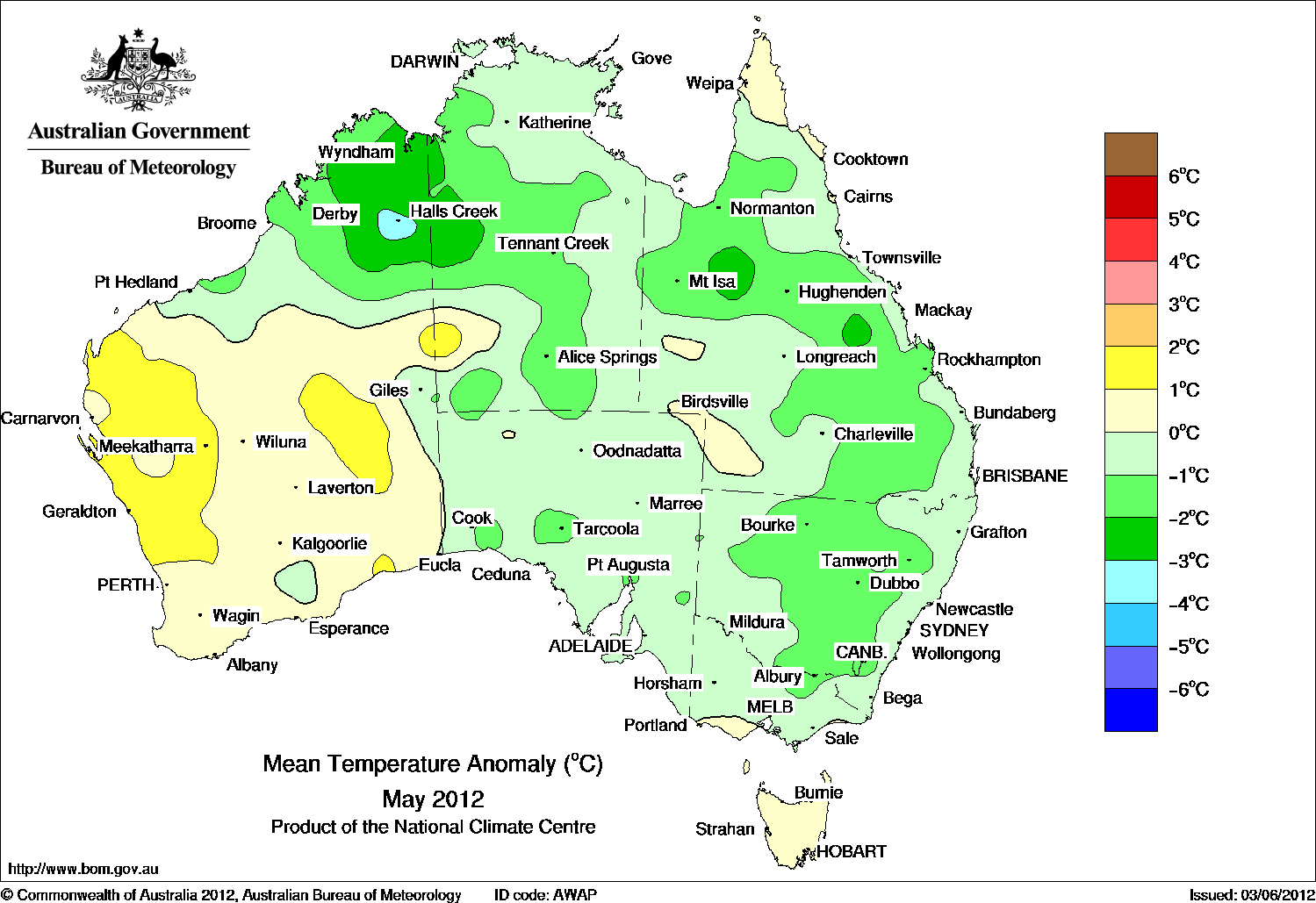
Lets look for the data now, at least for the fresh data collected in some official webs. May was not specially cold, it was hot in Greenland , it was above average in global temperature from satellites that skeptics love. Even UK and Australian temperature low records were not impressive as shown in figures below, it was hotter than average in UK and slightly cold in Australia. Although it is possible that there was a low temperature record somewhere in the world, but in that case this would be an example of extreme weather, wouldn’t it? Or maybe we can remember that weather and climate are not the same.

UK May temperatures from UK Met Office

UK May temperatures from UK Met Office

Australian May Temperatures from Australian Bureau of Meteorology

Australian May Temperatures from Australian Bureau of Meteorology

A pair of weeks ago I bought a parcel from Ljubliana (Slovenia) with tracking number and the possibility of checking the status of the parcel via web. It was a big parcel and everything arrived well and in a reasonable time. Nevertheless, my big surprise was to check the incredible route followed by it.

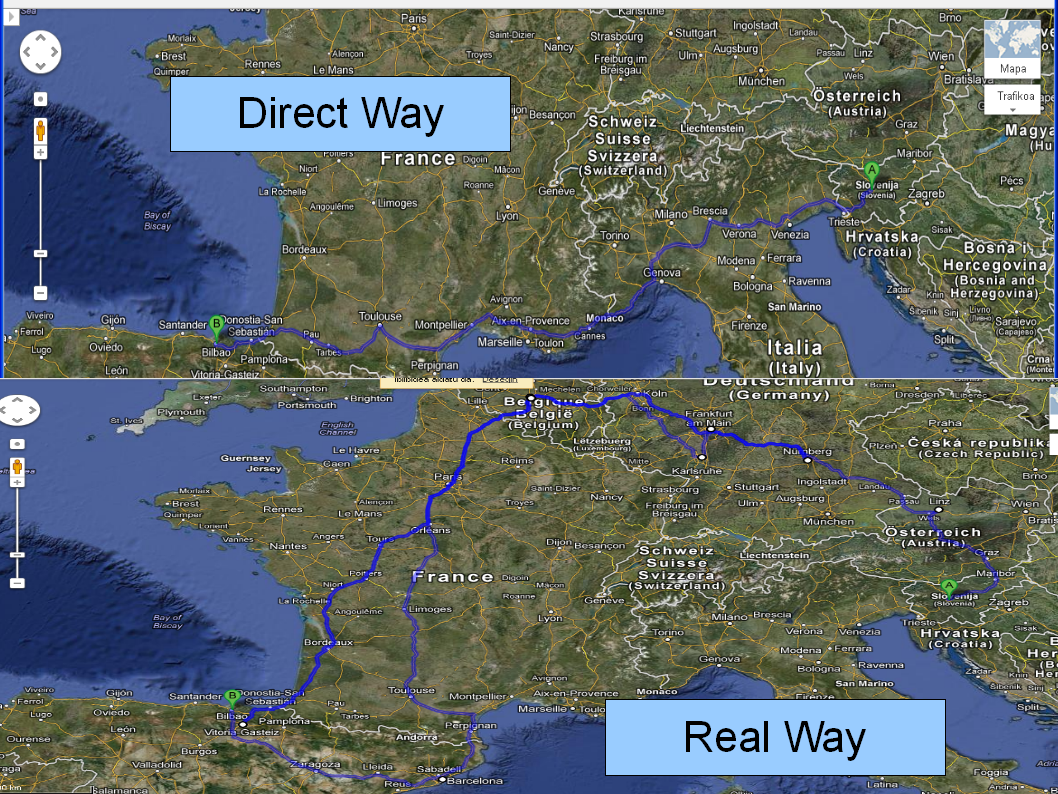
Following google maps the straight way is 1796 Km, quite long. I understand that shipping company cannot follow the direct way in every parcel, they have to use their intermediate transport centers. But the route of this one challenges any logistics considerations. It was this one: LJUBLJANA – LINZ – BRUSSELS – NUERNBERG- FRANKFURT – MANNHEIM – BRUSSELS – VITORIA – BRUSSELS – VITORIA – BARCELONA – VITORIA- and finally: Bilbao. More than 7100 Km, for times the minimum by road. The two routes are displayed in the figure below. Some aspects are really striking, as the three times it was in Brussels or in Vitoria, it had to get dizzy moving around this way.

Transportation is responsible of more or less a third of the CO2 emissions in most of the world and certainly there is room for improvement, as stated in this case. Because transport is not only ourself moving, it is also the movement of the things we buy and use. This web: sourcemap is a great resource to learn about it, I have to check it more.

Maybe a key point is that the fuel is not as expensive as we consider it or that the minute is considered more expensive or costly than the Km, at least for the moment. One way for improvement is to change this considerations and align cost to climate change effects. In my opinion this will become more widespread and accepted with the time, I hope it is not to late by then.

Parcel sightseeing EU

Two screenshots from Google Maps displaying the direct way recommended by maps and the actual way followed by the parcel.

I recently met twice this interesting concept, EROEI, I do not intend to give a better definition than wikipedia so I quote it:

energy returned on energy invested (EROEI or ERoEI); or energy return on investment (EROI), is the ratio of the amount of usable energy acquired from a particular energy resource to the amount of energy expended to obtain that energy resource

The easy and rough way: how much energy you need to get a unit of energy.

  • How much energy is neccessary to drill holes for getting oil, and then tranporting, refining,.. before final consumption in form of gas.
  • How much energy is needed to build a wind farm and the electricity net associated.

I like this concept because it is very physical and physicists love those things. Apart from that it is something that does not depend on economic circumstances or the influence of big companies in prices, or subsidies… The economy is more prone to account for short term interests and factors, so a more pure measurement system to compare different energy sources is welcomed. Of course it does not substitute the actual prices because nobody will accept it straightforward but it is another tool to takelong term decisions and understanding what’s going on. These 3 links go deeper in that concept, here, hear, and here. And finally this article in neofronteras that explains it very clearly in Spanish, as usual in that blog.

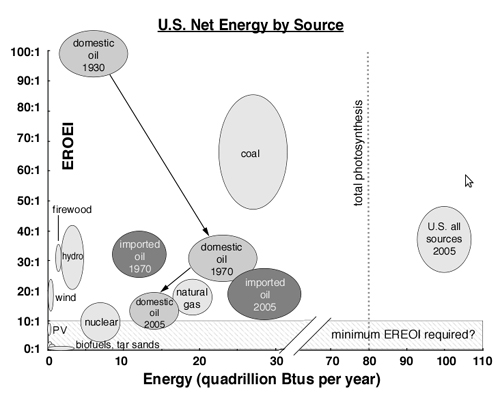
The calculated EROEI valujes range from 100 for oil almost in the surface to almost 1 or even less than one values for cases where the needed energy is more than the obtained.  It is considered that values below 10 are doubfully profitable and cases close to 1 should not be profitable at all but could be due to econonomical circunstances. Another factor is the time, that is not considered in this calcaulation and has led to other indexes as EIRR (last figure).

However, actual EROEI figures are not as pure as the concept and differ seiously from one source to other, you can check it in the figures below. Wind mills are ussually in the 20 values, quite good, there is also a coincidence about the lowering value of oil, but nuclear and coal prsent several different values. Photovoltaic is ussualy near the 10 limit. I do not know the cause of the divergence, I suppose it is not easy to calculate or maybe the same factors affecting energy economy are present here too, I will have to check it better.

At least, I agree with the idea that in the long term it is difficult to maintain a cheap low EROEI energy system, it would not be sustainable in any sense.

Another EROEI calculation, source, Searching for a miracle, but obtained from neofronteras.

Some EROEI calculations , source: Wikipedia

EIRR and EROEI from ococarbon.wordpress.org

EIRR and EROEI from ococarbon.wordpress.org