What do I think, What can I do?

Posts tagged ‘climate change’

What happenend to the coldest May on record?

Coldest May was a repetitive title in one skeptic blog. I explained the hilarity I felt reading this by the mid or even beginning of May considering we were wearing T-shirts not so far but left for later comment the data.

Certainly the enthusiasm about this issue in climaterealists peaked in the mid of May and declined from then, as shown in next table. And there was even a slightly critics post, but not too explicit. Another confusing aspect was the geographical correspondence of the coldest may, where was it coldest? In some posts it was mentioned the UK, in others could have been the world and in the last one in June it was Australia, many choices indeed.

Date 25-30 April 1-5 May 5-10 May 10-15 May 15-20 May 20-25 May 25-30 May 0-5 June
Number of Posts 5 0 3 9 3 2 3 2

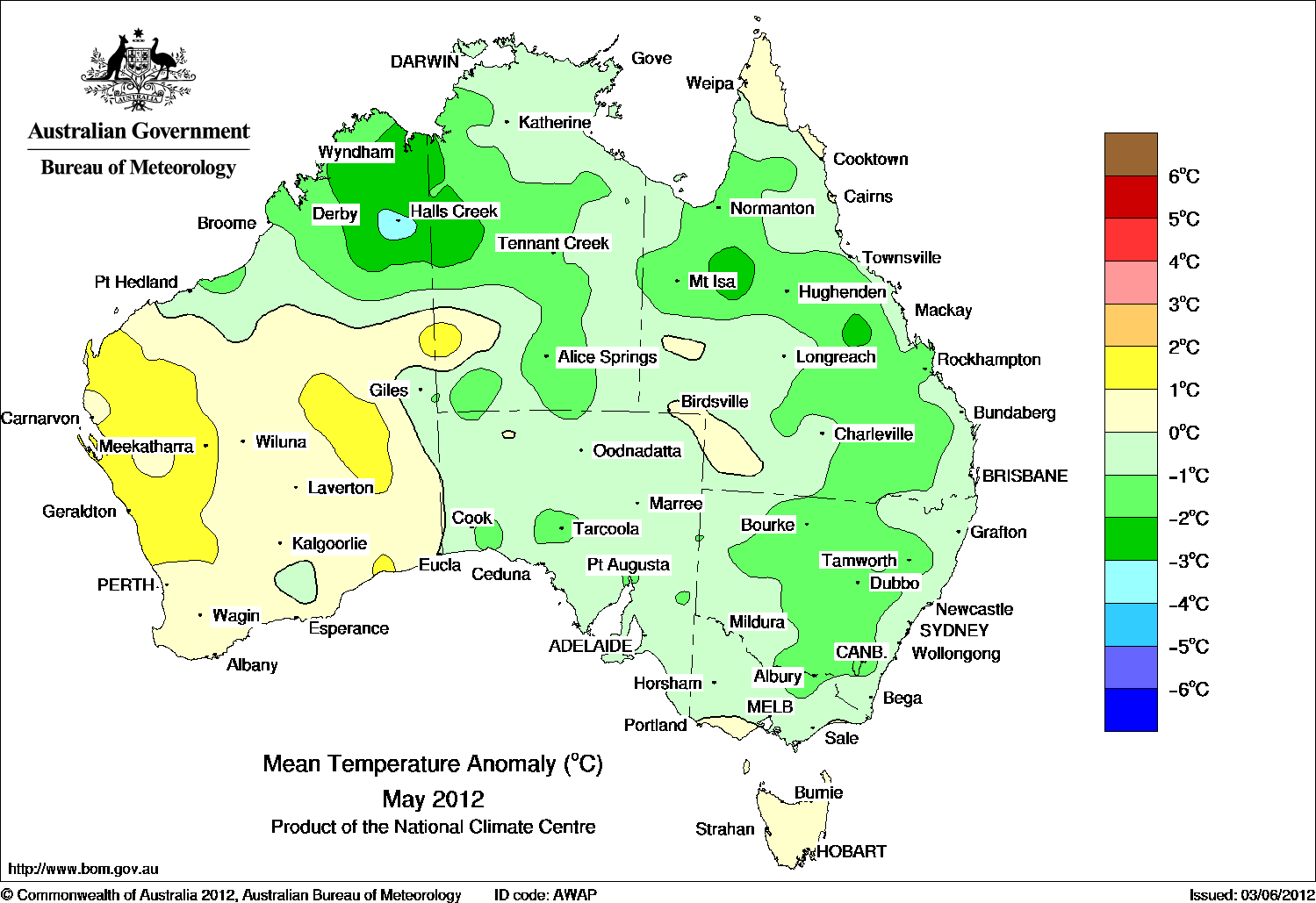
Lets look for the data now, at least for the fresh data collected in some official webs. May was not specially cold, it was hot in Greenland , it was above average in global temperature from satellites that skeptics love. Even UK and Australian temperature low records were not impressive as shown in figures below, it was hotter than average in UK and slightly cold in Australia. Although it is possible that there was a low temperature record somewhere in the world, but in that case this would be an example of extreme weather, wouldn’t it? Or maybe we can remember that weather and climate are not the same.

UK May temperatures from UK Met Office
UK May temperatures from UK Met Office

Australian May Temperatures from Australian Bureau of Meteorology
Australian May Temperatures from Australian Bureau of Meteorology

Story of one dizzy parcel

A pair of weeks ago I bought a parcel from Ljubliana (Slovenia) with tracking number and the possibility of checking the status of the parcel via web. It was a big parcel and everything arrived well and in a reasonable time. Nevertheless, my big surprise was to check the incredible route followed by it.

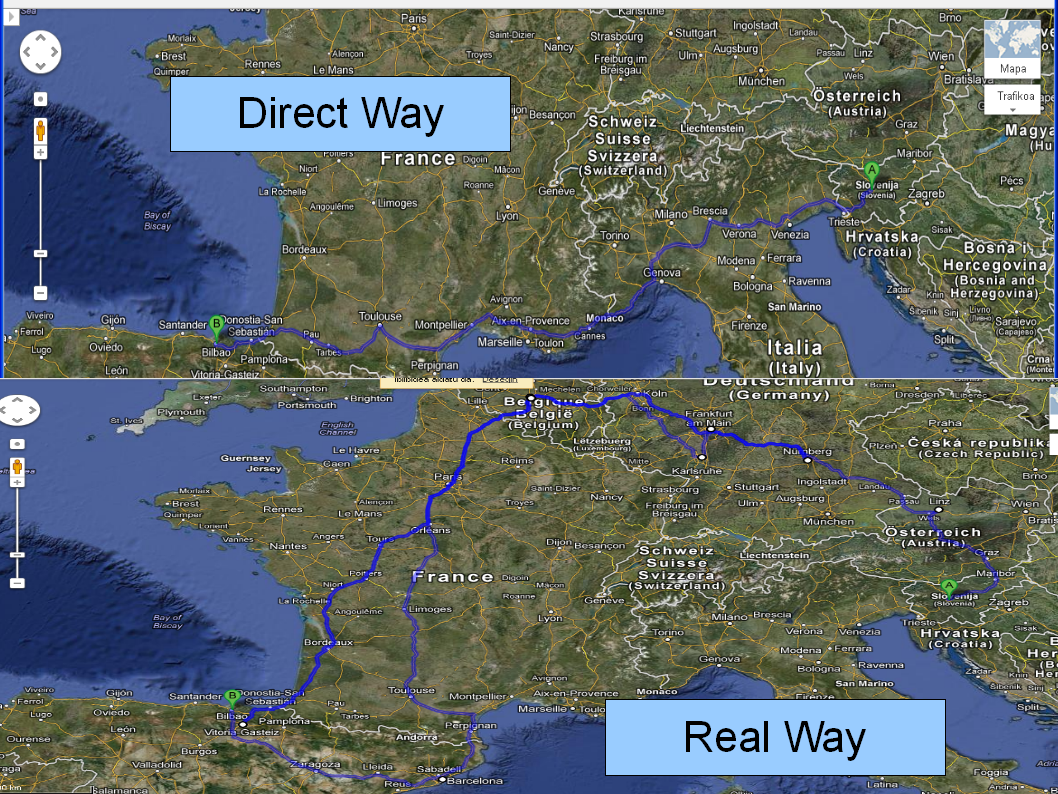
Following google maps the straight way is 1796 Km, quite long. I understand that shipping company cannot follow the direct way in every parcel, they have to use their intermediate transport centers. But the route of this one challenges any logistics considerations. It was this one: LJUBLJANA – LINZ – BRUSSELS – NUERNBERG- FRANKFURT – MANNHEIM – BRUSSELS – VITORIA – BRUSSELS – VITORIA – BARCELONA – VITORIA- and finally: Bilbao. More than 7100 Km, for times the minimum by road. The two routes are displayed in the figure below. Some aspects are really striking, as the three times it was in Brussels or in Vitoria, it had to get dizzy moving around this way.

Transportation is responsible of more or less a third of the CO2 emissions in most of the world and certainly there is room for improvement, as stated in this case. Because transport is not only ourself moving, it is also the movement of the things we buy and use. This web: sourcemap is a great resource to learn about it, I have to check it more.

Maybe a key point is that the fuel is not as expensive as we consider it or that the minute is considered more expensive or costly than the Km, at least for the moment. One way for improvement is to change this considerations and align cost to climate change effects. In my opinion this will become more widespread and accepted with the time, I hope it is not to late by then.

Parcel sightseeing EU

Two screenshots from Google Maps displaying the direct way recommended by maps and the actual way followed by the parcel.

Climate Change and Science fiction: Artificial Intelligence

Last week I watched in the TV this film from the beginning of this millennium (2001) Artificial Intelligence. .

As usual, I enjoyed the film. The concept of the robot wanting to become human and the limits of humanity is always a fruitful subject. It was brilliantly covered in Asimov’s novella Bicentennial Man, filmed two years before; although loaded in this case with the emotional charge of a child and the cruelty of a bunch of fearful humans towards the robots (the scene of the mix between roman circus and rodeo with the only amusement of destroying undefended old robots).

The final robot victory does not seem a consequence of any war but just a better adaptation to difficult circumstances, making it more interesting. Two personal comments: the role of the film for me is the teddy bear, and the robots are too perfect, even too perfect to be human.

Regarding climate change (this is the reason of this post) it has an indirect but noticeable presence, as Manhatan is underwater at the initial time in the film. So dramatic sea level increase is supposed more or less in 2100 (this is my educated guess). The “small contradiction comes just later, when all this water over Manhattan freezes in an apparent very cold climate. How it is possible to have everything frozen in New York but at the same time a sea level of a very warm climate, and all this in a 2000 year period. The only reasonable explanation is that Hollywood loves freezing New York.

The end could also be correlated with climate change somehow. The humans have disappeared leaving the planet to very polite robots. They do not seem angry with humans nor interested in their destruction, so it seems only a question of adaptation to catastrophic circumstances, and surely there have been severe climate changes as shown in Manhattan. So the film could suggest a complete destruction of human beings by climate change, or maybe it was necessary to get rid of the humans to get the final recognition of humanity for the robot-child.

Climate Change and Science fiction: The day after tomorrow

If there is one film showing climate change and talking openly about it this is The day after tomorrow.I saw some moments of it in the TV recently and in the cinema 8 years ago (incredible!!!)

Joe Romm did not like it, nor its message. May be I am less exigent or just am lucky enough to enjoy most of the times I go to a cinema (scarcely nowadays, it is a pity), I enjoyed it and consider it valuable to make us think about climate change. Why ?

Because even if the story is not terribly original it is easy to follow and get engaged with it. Because it mentions some of the issues of climate change, it is not only about warning the planet and using less heating, it is about changing the weather patterns dangerously, about changing ocean currents,… (OK it is not scientifically thought and can generate a confusion about climate change and ice age, but it is Hollywood and people know that films are not always accurate).

And the last reason to like it to some extent, is that it is the most explicit commercial film clearly related with climate change, comparing with many others that are just subtly related, this is a great positive argument. Many times films are great door to more elaborated knowledge for many, many people and we need a lot of people interested in learning about climate change.

Extreme weather and skepticism

Recently, IPCC launched a special report about extreme weather events (SREX). And the climate blogosphere has reacted, as it should.

Climate Hawks considered it correct but too soft in some senses. Joe Romm says it is a bit outdated regarding some articles, RealClimate does not agree with  one interpretation of statistics.

In the other hand, some climate skeptics have welcomed it effusively ,for example this one in spanish considers it a victory of the science.

This author was based in Piekle Jr blog and has read a different report really, because he considers that the report denies the occurrence of more extreme events in last years due to climate change. It has been one of the most striking examples of cherry picking I have come across last times, and there are many of those (I love this word).

A last example is the vegan blog from which I took the photo. They consider the link established and the occurrence clear. Yes , reading the same report.

I haven’t read it thoroughly but I agree more with the vegans, the report is written in a scientific tone, not a journalist one, but clearly talks about the risks increment due of extreme events.

This is an important battlefield in climate change, extreme events are an important negative consequence of climate change but at the same time are a great driving force for public opinion. Average temperatures are not easy to notice whereas terrible floods or hurricanes or droughts are impossible to forget. Even when they are not scientifically considered a climate change consequence they exert a great effect. Sometimes the science come to us in unexpected ways. For these reasons we will continue to discuss about them.

And painfully to suffer them unless we change our emissions path fast.

Earth Hour in four days

This Saturday, with the hope of the beginning of Spring in Northen Hemisphere an interesting event will take place: the earth hour. I think I remember it or something similar from other years, but in any case I got the news from a street advertisement (classical media are still useful to some extent, although it would be great to get it from Angry Birds). In their web  explain it started in Australia in 2007, it is widespread now throughout the world, it is organized by WWF and wants us to make a contribution against climate change. The actions consists of turning of lights for one our from 20:30 to 21:30 on Saturday. I understand that it is local time, so it will not be simultaneous for all. I suposse that a coordination of a simoultaneous one is much more difficult but it would really funny for any astronaute or an alien observer.

Now, that were are in strike and demonstration times in Europe this other way to revindicate things its quite refreshing for me. New times, global problems and posibilities require global actions and new ways for cityzens in any part of the world. I think it has many unexplored possiblilities not only for general reivindication but also for more concrete ones.  For example, recently there was a crowded demonstration asking to shut down Garoña nuclear power station, most people living close to it, particularly in Basque Country is quite worried by this old nuclear very similar to Fukushima.  Demostrations are OK, but maybe a massive reduction of power requirement and commercialization might be more worrisome to the owners of the power station or the Goverment making the decision.

I believe in the joined power of small citizens, it is something we need in climate change, we need a big and diversified driving force. Making concrete things is a way to start and feel you get some reward. It is just a symbol, but it could help to gain moment. Next saturday I will try to shut down the lights and if we are lucky and more people shuts down their lights and the clouds go to another place enojy one hour of starry night in the city. I will prepare the telescope.

Science Fiction and Climate Change: Matrix

I am going to start my small, personal review of science fiction and climate change with Matrix. Although this is not a film anyone would relate with climate change it deserves a place in the hearts of science fiction lovers, at least for me. The nightmare of being harvested and artificially entertained by a quite imperfect world not so different from the real one was terrible and fascinating at the same time and the visual effects were a step beyond in 1999. Incredible.

But I am not here to comment the film, just to find a subtle connection with climate change.  Lets read the scrpit:

Morpheus : A singular consciousness that spawned an entire race of machines. We don’t know who struck first – us, or them. But we know it was us that scorched the sky. At the time they were dependent on solar power and it was believed that they would be unable to survive without an energy source as abundant as the sun. Throughout human history, we have been dependent on machines to survive. Fate, it seems, is not without a sense of irony.

In this case not exactly climate change but solar energy. As Morpheus explains to Nero the machines were powered by solar energy, all of them, and humans induced a kind of black out of it to destroy the machines. The situation in the film of humans as energy sources, comes from that. Of course, scientifically a human body is not very effective to produce energy, it produces heat but wasting energy that comes from plants, and eventually from the sun. So this idea is nonsense but the faith of solar power in the late nineties is remarkable. I wish it was more widespread now.

Climate change and Science Fiction

Image from wikipedia

Recently, Joe Romm wrote a very interesting autocritic post ,  where he complained about the low coverage of climate change in media and particularly in cinema.

In the first moment I thought I disagree with this opnion. After a second thought I am not sure. But doubts are frequently a good opportunity, so I am going to try to use it to do something I had in mind since some time: to look for links between climate change and Science Fiction, books and cinema in a broad and not too systematic sense.

I know this is not a key issue. Science Fiction is a hard to define combination of science, technology, expectations, fantasy and literature. Because of that, it does not prove any scientific fact, but it can be an index of the interest of a subject in a moment and I love it.

Finally, in spite of it’s lack of provatory value it can exert an influence in public opinion and help us make more conscious of climate change or other topics, particularly in the case of cinema.

Climate Wars: The war on books.

This battle is not a real battle as the stolen email case (climategates vs. Herathland institute). It is
a different fight mostly dialectic but a fight after all. It is about books. One month ago a german book was considered a great success in skeptic blogs: Die Kalte Sonne. Two were the main reasons for skeptic joy, one of the authors had been an important environmentalist in Germany and the book was quite successful in Amazon Germany, at least before selling. Climate Hawks did not mention this too much except the answer in SKS, explaining the links of the author with energy industry and the mistakes contained in the book.

A bit later the most mentioned climatologists Michael Mann published a book about climate science and its wars. This book was harshly criticized by most famous skeptic blog WUWT as it uses to be anything Mann does. But this campaign reached again Amazon (definitively a battlefield) following the WUWT recommendation to vote it negatively. The defense came from Joe Romm in a nice to read post thinking about Amazons review system but at the same time taking care about ethics limits. In my opinion contrary to the emails one, this was a victorious battle, at least in the weapon choice. I bought Mann’s book for Kindle (I hope to read it someday).

At the same time this kind of books are not only interesting for their readers, the presentation of the book is a great opportunity for general media to remember climate change and say something meaningful and more effective than the book itself (I really have to put it in this year full list). And maybe someone will be interested enough to read it and get more conscious of climate change challenges.

Climate Wars: stolen emails

War , source: libcom.org

The discussion about climate change has many fronts. Last week one of the main issues was the stolen emails from Heartland Institute. It was in fact a kind of answer to the previous climategate1 and climategate2. The climategates were a series of emails stolen to East Anglia University climate scientists that skeptic blogs considered were probing the climate change failure. They just show discussion and reasonable doubt about climatologists and all the ingestisgations have found them no-gilty of fraud. The responsible of the theft is unkonwn.

In this last case, the Heartland Institute is a skeptic institution and the stolen emails show what was easy to suppose, that they are founded by big companies close to fossil fuels. There is a strong arguing about the veracity of one of the documents but everybody accepts that most are real. However, one of the main differences was that in this case the author of the theft has revealed himself and it is a known scientists and climate activist, Gleick.

The skeptic blogs have not stopped to mention this issue once and again, to say they knew it, to show that this probes climate science is a fake, to say that many others are like him,… Just a simple data, in the 6 days from February the 20th to February 26th it is the main topic for 20 posts in WUWT. More than 3 per day, I would not be able to make even 3!!! Really prolific. The rest of skeptic blogosphere follows the same behavior of course. In climate hawks blogosphere it is mentioned and even source of discussions between David Appell and Joe Romm.

One curious aspect is that Heartland Institute was very active using climategate emails to criticize many scientists, while now it is claiming that stolen emails should not be used against themand even send strong emails to many bloggers. The letter of many of the climatologists explaining this contradiction in first person is one of the few positive things of all this issue.

Because stealing those emails has not revealed too many new things but has situated this war in the battlefield wanted by skeptics, because the question here is not who has done it more ethically or who has stronger ethical reasons in this war, the question is that credibility is one of the biggest treasures in this war and the one who owns it (the science) is the one who can loose it in this kind of battlefield. We can not forget that we are saying to our fellow citizens: we have a big problem and we will have to change many things in our lives to cope with it. The skeptics are saying: forget about it, they are trying to lie. For this reason this action of Gleick is not only ethically acceptable because this is a war, it has even lead to a lost battle in the battlefield of credibility.

This way, we are discussing about what email was stolen or who wrote a document instead of thinking about what can we do to reduce our emissions and mitigate climate change.