What do I think, What can I do?

Posts tagged ‘cost’

Some Words about Fukushima

Fukushima

Imagen from the reactors (From http://www.fayerwayer.com cc)

I wrote this title when Fukushima was a mayor headline, and after that I left blog writing for some months. However, Fukushima still holds some interest in my blog apart from the overwhelming tragedy for zone inhabitants, workers and most Japanese in general.

I wrote in a previous post that nuclear was dangerous but at the same time give us important KW*h not easy to substitute in this moment. I still hold this opinion in spite of the disaster. We have checked that nuclear security fails in some cases (it was extraordinary I admit it) and when it fails the consequences are disastrous but closing all of them together is a price we can’t afford in this moment. I prefer to maintain their installed power while we close the oldest and less secure, and even accept to install a new one in some cases to maintain power.

Nevertheless all this should be conditioned to rigorous security checks. Just thinking that there is a very old nuclear power station at 60 Km from my home makes me feel quite edgy and knowing the desing is not different from Fukushima even more. But the main idea I wanted to work was about the cost of Fukushima. Without knowing the details I think it is clear it will be very expensive, however making some simple figures it becomes much worse.

Following Doc’s green blog the total cost may reach $50000 million, so $5*10^10. Considering total energy output per year for nuclear plants is around  2.5 10^12  KW*h (2009 data from WWI), it gives us a rough estimate of 2 cent per KW*h over the whole world production of nuclear energy this year. It is not despisable, and will likely be paid to a great extent by Japanese goverment and so Japanesee in general.

Do you consider it a subsidy for nuclear? I do.

Why can´t be my roof white?

I live in a 9 plant house and we are facing several maintenence/repairing operation last years due to the age of the building. With my limited knowledge I participate in a small comission to check our next project, which involves changing our wasted roof.  As we were talking with the architach about the project Y asked why we could not use a white material (or at least paint it) instaed of the greyish one we will finally use. He simply did not take the question into consideration.

Maybe he thought it was about aestetics but it was about albedo.  This strange word plays a role in our climate and can be explained with few words (although maybe not bery precisely): It is the amount of light and so, energy, from our sun that our land reflects. For that reason a quick trick to improve our situation could be to increase this and reflect more solar radiation. I know it sounds quite artificial, but we are not in a situation with too many choices and anyway we are reducing our albedo by melting several glaciers and polar snow. And its easy and in many cases costless at least in some buildings, roofs, etc… It is not the definitive solution for climate change but it could help.

Composition if 3 images from Google Maps. Left: My home city with red roofs, not very reflective. Right: An industrial area not far from the left image, the albedo is much higher. Bottom: Image from Iceland snow, real great albedo.

However, it is not commented anywhere and no goverment (local or higuer) has it included in building rules or politics. So, standard arquitetchs and building material producers will continue thinking it is about colour preference.

I would not be difficult to encourage people to love white for their houses roofs and we could counteract some tons of CO2 without terrible effort. Or at least explain its possibilities for all of us to make choices.

110 kph for saving energy, money or both?

Last week spanish government is facing severe criticism for proposing a maximum speed reduction from 120 to 110 kph in speedways. The mentioned reason is to save money due to petroleum price increase due to Libian uprising. I am not going to the political issue or discussion and different aspects of the proposal or how it has been explained or decided. This kind of measure is not new (speed limit), and the opposing opinions either.

Souce: Wikipedia. Author KaterBegemot. Speed limits in Europe

What really worries me and at the same time shows some opportunities are two questions:

  1. When energy and/or petroleum become very expensive, someone is forced to save, people, the government, companies,…  If we could reflect some cost of Climate change in nowadays main energy sources cost debates would be completely different.
  2. It is not easy to reduce our power to go fast, to consume what we want, to waste resources. It is unpopular because we do not link this to a greater future improvement. We mainly see our immediate loss. This is applicable to electricity costs, flights costs, and many other things.

But the question could be understood from a different point of view. Maybe we have lived last century from energy resources accumulated during millions of years and our credit is finishing because this expenditure is too much for our climate. So we could recognize it and start changing by ourselves with conscious sacrifice, or let the atmosphere act in our society, economy and so on and be forced to change late, worse prepared and fighting each other.

Because if we want to reduce speed and gas consumption a law nor any government is not really needed.

Light Pollution and Climate Change

It can be considered a secondary problem and certainly it is not comparable to many possible consequences of climate change as: floods, draughts, sea raising, … But, in my opinion, it is at the same time a nice and interesting symbol.

It is quite striking to realize that most prominent astronomers from XVI to XVIII centuries worked from cities. Visiting Greenwich Royal Observatory just in the outskirts of London was a real pleasure and a surprise for me.  Whereas nowadays almost everyone living in a city knows how difficult is to see any star in the night sky. In my case, the very frequently cloudy sky is another important factor too. But even for cloudless cities light pollution is a nightmare for many astronomers, and some of them are taking action against it (there are many links , those three are just a small sample: IDA, wonderful maps, Cel Fosc).  Congratulations for all of them.

Italian peninsula light pollution development, Source: http://www.lightpollution.it/

But for the moment as clearly shown in the picture we have lost hte opportunity to see the universe’s beauty. And we, urban cityzens are more than half of human population. This loss can be critizised from many point of views:

  • A phylosophycal one:the loss of perspective of the universe.
  • A scientific one: we can’t see the stars, and many amateurs find it more difficult to make contributions for general knowledge.
  • A stetical one: we are loosing a wonderful spectacle.
  • An historical one: we are getting disconnected with the night sights contemplated by our grandparents.
  • And a climate change one: We are wasting much of the light emmited by our lamps. So, we are throwing millions of tons of CO2 just to disturb astronomers, and sky lovers in general. This is an evident inefficiency and quite an interesting potential gain, we could save CO2 tons and improve this subjetive concept named quality of life.


The other nuclear: Fusion Power

Some time ago I saw an interesting documentary in the TV about nuclear fusion. It was very nice to see and closely related with climate change. As it uses to happen in this program  the contents were built around a pre-eminent scientist. In this case the main character was Steven Cowley. He defended convincingly the future of this technology, explained very clearly the basic ideas and some difficulties and recognised without doubt the risk of climate change.
I was a pleasure to watch this program. I only disagree in one aspect, about the solutions to climate change. Of course, Steven was convinced that Fusion was an important part of the solution of energy production for our world, he also considered important an alternative mobility (electric car or similar) and solar power. My doubts arise basically in the first one, I can not deny nuclear fusion could be a wonderful solution for universal, cheap and centralized energy. In fact it is our main energy source as the sun is fuelled in this way and the sun is the source for fossil fuels, hidropower, wind mills, solar,…

But in the same way I doubt about conventional nuclear power, I am not sure of the short or medium term possibilities of this energy source. The expected times are always 20-30 years later and the very expensive projects are fully international (very respectable and positive but also showing a poor confidence in its profitability). It would be wonderful, maybe it will be wonderful sometime, but do we have enough time? In my opinion is wiser to act with easier or closer possible ways and not thinking too much in magic solutions. Because if you buy a house based in a possible but not clear future incredible job, you can loose this big house and the possibility of a modest one.

Anyway, I support employing public money for fusion investigation, but just in case lets act as if were not successful.

More spills and $/€ moving arround

One interesting point of view to embrace climate change struggle is the practical one. Instead of less widespread ethic or environmental criteria the practical point of view should be able to reach a wider spectrum of people living their own busy urban life without too much time to worry for far problems (far geographically, socially or in time). Because if this is something that may affect my own small life it is more likely I will find some time or effort to do something or change something in my behaviour, or, at least accept stoically an imposed sacrifice.

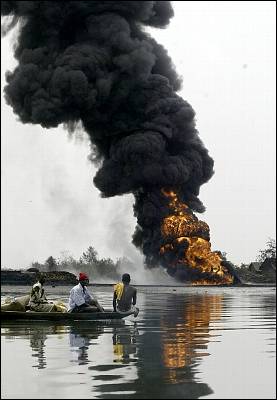
This way of thinking was mentioned in this blog before related with BP oil spill. And I have just recalled it after reading news from other not so famous spills. Or the not so far China spill . How much are we paying in many ways for all this spills? How expensive is really the petroleum dependence nowadays?

Sceptics will continue to explain carbon-free economy is too expensive, impossibly expensive. Are they considering all the cost in this moment?  And the future ones? And the risks? And the cost of the risks?

The eternal problem again: actual cost are “easy” to measure, at least some of them, while future ones are difficult to measure or maybe easy to forget.

How expensive is to allow Climate Change?

One of the most used arguments against Climate Change action is that is quite “expensive”, and it will be, bnecause important changes will have to be made in many aspects of our economy and life. We will be able to get less objects and services with the same effort, so, in practice, we will be poorer in average.

However, Climate Change will be very costly too, even more than changing our cheap carbon economy as explained by Tony Blair.

And some costs are not so easy to account, for example a massive oil spill in the ocean. Who will pay all these destruction? Can it be paid

Nevertheless, the real problem is more about time than about total cost. Climate Change avoiding or softening strategies have to be paid now, at least start to be paid now and the consecuences will come later, some are just perceivable but the most severe and “expensive” are one or two generations ahead. And we are not used to save for so long.