What do I think, What can I do?

Posts tagged ‘“renewable energy”’

Biomass for heating

im003235Today, I have been in a meeting were representants from three small towns (Aramaio, Otxandio, Zerain) explained their intention to develop Distric Heating for the greatest part of their town using wood from their own lands. There were some differences in the concepts, the scope, the development stage and the size of the towns that ranges from 300 to 1500 inhabitants. At the same time, there were some interesting common points too:

  • The Biomass from forests was the main energy source for our grandparents for more than 1000 years.
  • The investment needed to start the system was a problem for most due to the low-budget of the towns but they all were considered that the change from oil or gas to local Biomass would make economic sense in the mid-term, and they had done detailed studies for that.
  • It would also benefit local wood producers as their income would be fixed in the long-term.
  • It would create local jobs.
  • It would help to prevent wildfires.
  • It would make environmental sense.
  • It would complement well other local economic activities as tourism or sheep growing.
  • It would be compatible with forest harvesting for more expensive use of wood.
  • Their projects were based on local wood, a wood moving 100 Km would be too expensive.
  • They would need more help than the one their are getting.
  • And the last one, they have discarded other renewables after some preliminary studies.

And my own conclusions:

  • Our forests can be used for different purposes at the same time and even if I usually do not mention land use it is an important issue in climate change.
  • Biomass heating use of second quality wood is a nice substitute of gas or oil for small towns with forests, but can even work for Distric Heating of buildings in nearby cities. It will not heat everyone everywhere but can be part of the solution, and this is what we are looking for: partial substitutes of fossil fuels.
  • Local approaches can be important, maybe more than in global emission numbers, as an example and motivation, like el Hierro island
  • The only discouraging news was the low acceptance of other renewables in their studies, and the worst case of three small hydro power stations that were not used after being abandoned in the cheap oil times. Certainly, in some cases the information they got was not updated. But this is something that happens many times.



China and Climate Change

China and World emission paths. The magnitude of the emissions if different but the scales are the same

China and World emission paths. The magnitude of the emissions if different but the scales are the same

Now that we are close to the new year eve in China it is a good time to write something about them. The figure in the beginning of the post displays how influential is China in the current emission path of the world.  25% of the emissions come from there, if the rest of the world would suddenly stop every emission China’s CO2 would be enough to be over the 20% maximum that is considered a reasonable equilibrium. Even more important than the share (lower than the population share) is the trend, whereas most developed countries are not increasing their emissions significantly lasts years Chinese CO2 is growing very fast. It is not the only one but it is the greatest and I think that the leader of the developing-developed countries group. In a previous posts I mentioned USA and China as keys. They are, all of us are to some extent. However, I think that China will fix the trend that many others will follow, because they can reverse the upwards emission path and fix the peak, after that the perspective will be different.

And how is it doing in China? I am not an expert and see news of both sides. In one part, they are burning half of the coal of the world, if they do not stop we will get quite hot.In the other hand there are signs for hope as most Chinese are convinced of the importance of climate change, they want to be more active in renewables and form part of International Renewable Energy Agency (IRENA) and even if their 6 ton per capita emissions per year are not far from many European countries (but far from the USA), they burn them in part to produce goods that export. Transport emissions are low for example.

Apart from those news there are three great reasons I believe should make us hopeful :

  • Chinese are quite vulnerable to extreme weather, so for climate change. It is they fight as it is everybody
  • They have the opportunity to lead the development of many renewable energy technologies.
  • They have the opportunity to build many things in their society in a low-carbon way and this is much easier than transforming high carbon structures.

Last chapters in Spanish energy politics regression

definanzas.com.wp-content.uploads.energias-renovablesI started this post many time ago. And every now and then there are novelties, so it is like an never-ending post. Therefore, I have decided to stop and publish.

There was a time, not so far ago when Obama considered Spanish energy politics as a good example. A favourable Feed-in-tariff helped the development of a strong industry capable of exporting technology and an amazing 44% of electrical generation from renewables in January 2013 is an example of what was done. But this panorama, quite succesful, in fact, started to decline some time ago, concretely with the previous socialist government. And the current one, from the conservative party is deepening the problem and forcing the companies to look only abroad for new contracts.

After stopping feed-in-tariff for new installations the subsequent changes have attacked the installed solar panels and wind mills. The suggestion of removing the TUR tariff (the fixed tariff for most small consumers 99.6% of the consumers but only 50% of the KWh) was just a step. The general 6% new tax for all electricity generation followed.  And, last week a new change in feed-in-tarif for the active installations was designed with the tariff deficit in mind again.

But it does not stop there, efficiency measurements have been stopped too in a way quite difficult to understand. In one way european building efficiency directive has not been converted in law (it should be long ago) and this could be clearly an impulse for a collapsed building sector and certainly a help to save petroleum and gas expenditure and many of the programs from IDAE institute have been cancelled to support car sales (PIVE plan). The result is a record expenditure in fossil fuel imports. Is it not a bit contradictory with tariff deficit reduction philosophy? The only two good news are that el Hierro will not be affected nor a thermosolar central (just one).

It is clear from the beginning that Soria (industry and energy minister) has been mainly worried to reduce a very strange concept called “tariff deficit” , i. e. the difference between the attributed energy production costs and the final market value (TUR for most of the consumers). This difference has been steadily increasing in the last years and it is considered a debt of the consumers (or government I am snot sure) towards energy producing companies. Even if they have earned considerable money in spite of not getting all the attribution costs. Nowadays, with a terrible financial crisis this kind of debt is a heavy burden and Soria blames the renewables for it. Yet, there are data that  say the blame should be shared by many others as gas. Meanwhile the electricity demand continues falling with the economy and Soria is afraid this will continue to harm main energy companies.

I agree that the system was flawed, and that currently installed renewables are more expensive than some other energy types in direct costs but at the same time I think the whole electricity production and paying system should be redefined. It should be more transparent, clear and new renewables should have a reasonable possibility to enter as currently they are cheaper than ever, had a consolidated industry behind and produce many other benefits as jobs and reduction of CO2 footprint (Spain’s vulnerability to climate change is not low). By the way:

  • why not electrify transport to increment electricity demand but not energy demand?
  • or, why so much delay in self-supply regulation? If solar panel are expensive only the really convinced will install them and it they are not.
  • or, even better, why not simplify the system and introduce a carbon tax instead of the many other taxes to rightly account for actual externalities of the  different energy production processes?

Finally, the biggest problem with all this is the uncertainty it produces for other countries to start ambitious programs of  renewable energy. Spain was an example for energy transformation and it is at risk of becoming an example about how such a process could be spoiled. Nevertheless, the game is not over yet, a 44% of renewable electricity production in January (not based on Hydro power) is still a great number.

Renewable Electricity, many reasons for hope

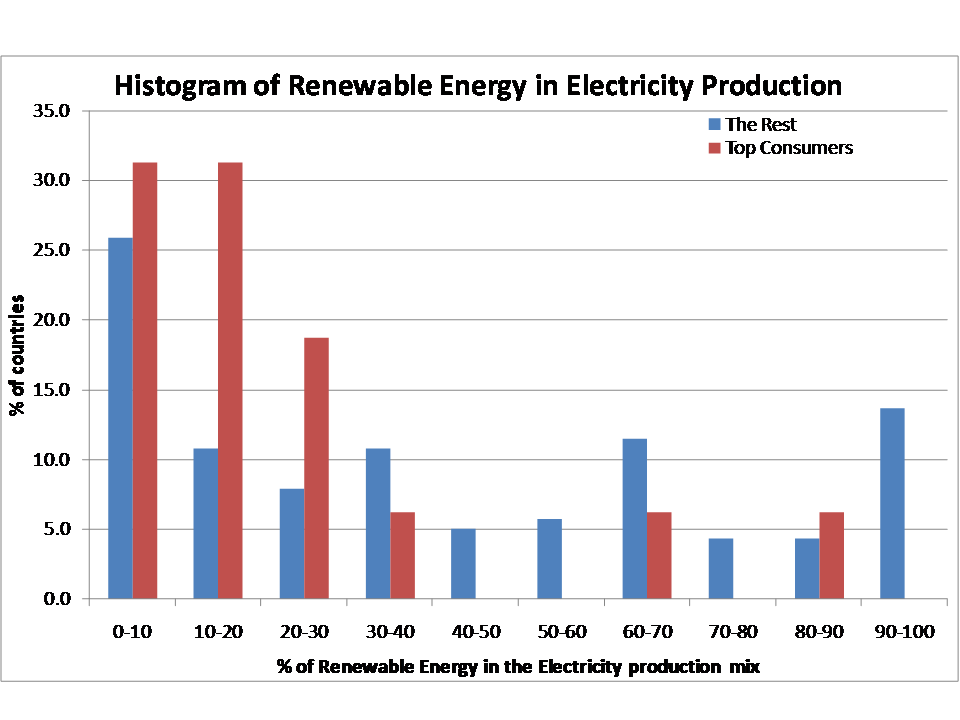
In a previous post, I mentioned the rough figure of 42% of the energy in the world devoted to electricity production, sometimes,  when we talk about energy and climate change we only think in electricity. It is a mistake I do frequently. So, OK it is just 42%, it is not all but it is almost half of the problem. So it seems a good starting point for the solution as well. And though the situation is not wonderful and we are in a hurry, there are some sings for hope just in the electricity production data by country. They are in the following figures:

Share of renewable electricity by country, divided in the top consumers (80% of world electricity) and the rest

Share of renewable electricity by country, divided in the top consumers (80% of world electricity) and the rest

Share of Hydro power in the total renewable electricity by country, divided in the top consumers (80% of world electricity) and the rest

Share of Hydro power in the total renewable electricity by country, divided in the top consumers (80% of world electricity) and the rest

The so-called top producers correspond to the 16 countries that concentrate the 80% of consumption, the data come from the Wikipedia and are from 2009-2010, in this moment they should be better for many places.

Anyway, my hope comes from those facts:

  • The top producers are less renewable than the rest. But even there, there  are 2 countries with most electricity from renewables, so it is possible to maintain a “big” electricity system this way.
  • “The rest” show a lot of countries very renewable. It is hopeful because they should be the ones needing more new energy, so they can install it renewable. In th other hand this confirms that the problem and solution is concentrated in a few bunch of countries.
  • Among “the rest” hydro power is their main source of renewable energy, among top consumers too, but with significant amount of others as wind, solar or even Geothermal. This is interesting as the future and present should come from them.
  • Finally, electricity can be the way to decarbonize other sectors as transport (the road is the most important contributor there)

The rough figure of World emissions

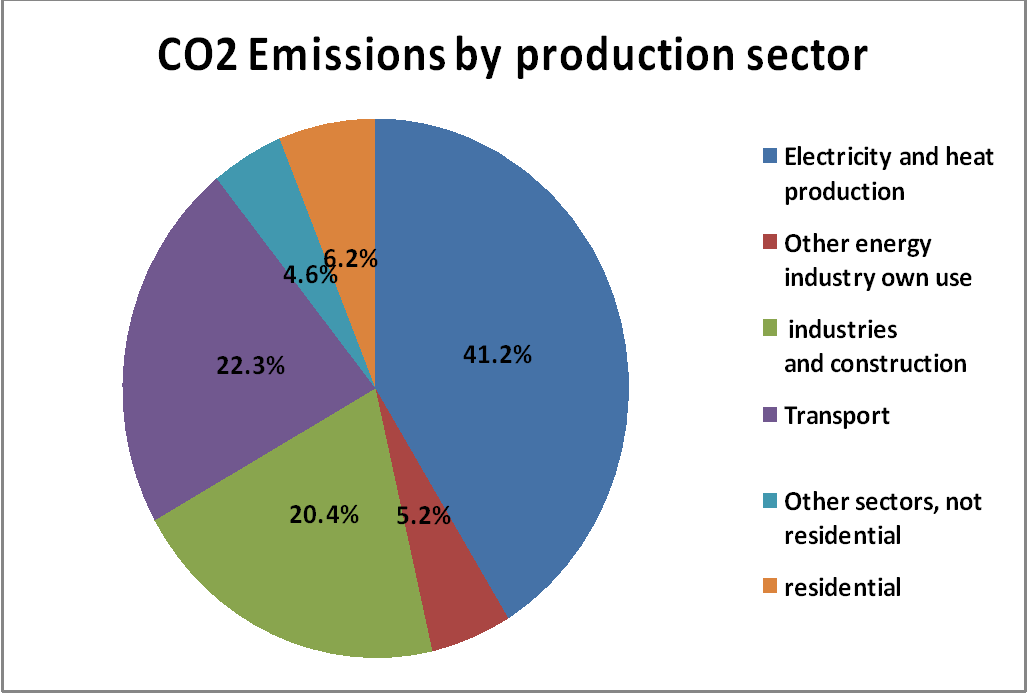
CO2 Emission percentaje by production sector in the world, source of data IEA.

CO2 Emission percentage by production sector in the world, source of data IEA.

I frequently think that the climate change solution is in transforming the power production sector and consumers mentality somehow. However, many times remember too that transportation is important and I got in mind the simple figure that one out of three CO2 tons comes from transport. Rough numbers help but it is always better to be more precise, and the two figures in this blog follow this purpose. They have been obtained with the open data from the Internationa Egergy Agency (IEA) and show total emissions in 2010.

The first one, at the beginning, displays the emission proportions by emission production sectors. In some cases, these divisions are not easy to understand but the main conclusion can be that electricity production is responsible for more than 40% of emissions and this is good news in my opinion because the progress in low-carbon electricity production has been much fester than in other factors and because in fact there are many countries producing most of their electricity without fossil fuels. Transport and industry account for other more or less 20% each (in industry excluding electricity use). Transport is a bit lower that the 33% that I expected and it is mainly road transport. Residential sector is surprisingly low.

CO2 Emission percentaje by consuming sector in the world, source of data IEA.

CO2 Emission percentaje by consuming sector in the world, source of data IEA.

In the other hand, the last figure classifies the same data by consuming sector. So roughly, industry is the objects we use, transport is transport and residential our houses. In this case, industry leads the figure with 36%, and transport and residential follow close to 20%.

The main reference is that we should reach 10-20% of current emissions to be on the safe side, so we have to make important effort in all areas.

Summary of my climate change snapshops from my holidays in the Canary islands

My holidays are getting very far, evolving into not very clear memories. Yet I wanted to write a summary post with my thoughts and I have been delaying it, but today, in one way or another I have posted it.

When I travel, I frequently look for images or facts related with climate change, renewable energies,…  This year I have even post some of them as:

My mental short summary now is that Canary islands have a lot to lose from climate change because having a wonderful climate any change will likely be negative and climate is central for the two main economic sectors there: agriculture and tourism. But, this scaring risks can also become opportunities as the experience of making El Hierro a renewable island shows, and I firmy believe in the potential of Canary islands. In fact, the same stubbornness of La Palma inhabitants not to allow any new industry they consider contaminant could lead them to a more renewable energy. They have two great advantages,  they do not have to feed a large electricity hungry industry and they do not suffer from cold or heat at their homes (for the moment).

By the way, why not try to reasearch geothermal generation possibilities in islands with active volcanos,  if they are useful to amuse the tourists by cooking tasteful meals (in Lanzarote) they could also be useful for something more productive.

El Hierro, a renewable island

A map from El Hierro island

A map from El Hierro island

El Hierro is the smallest of the main Canary islands, with only 278 Km2 and 10000 inhabitants maybe for this reason it was the perfect place to accomplish an ambitious project: Get its electricity only from renewable sources. 5 wind mills will be enough for that but supported by an energy storage system, when the mills are not producing electricity for the grid they will feed pumps to raise sea water to a natural deposit. In case electricity is needed and there is no wind a hydropower station will work with this water coming from the deposit. A more detailed explanation is here.

Although small (10000 people) this project is ambitious and promising at the same time. Why? Because it works in a scale between the big country and the familiar house but at the same time it is a complete electrical system as Canary islands are not connected to other grids and for this reasons they have been reluctant to introduce too many renewable sources that would challenge the stability of their small grids fueled with diesel power plants. So it has been easier to try a total replacement (although fuel power plants will continue to be operative for backup) that a mixed system.

At the same time this is an opportunity, because Canarian electricity is expensive, more expensive than standard renewable technology and I haven’t found the cost of this project but it would not surprise me to find it is cheaper in the long-term that standard power production in El Hierro. This data would be great to make a more precise assessment.

Anyway, the most important achievement of this project in my opinion is that renewables have been able to become the main power generation source in a whole electrical system that clearly is in another scale compared to a household. It is a 10000 people scale distributed in a 278 Km2 location. By itself it will not change the general emission trend of the world because even if there are 700 million people living in islands, most of those inhabitants live in much greater islands. But it is a step to change scale and every difficult achievement has been done step by step.

There are internal fights in Spanish government about Energy politics

The conservative government in Spain is breaking records in its politics against renewable energy. The time where Obama mentioned Spain as example seems far away. After Rajoy took office one of the first energy politics by Industry minister caller Soria was to stop feed-in-tarif. Later, it went even further planning a new tax for some energy sources, for example renewables. The great driving force in Sorias speeches was “tarif-deficit“, a concept deserving a post by itself but roughly defined as the difference of accepted official prizes for energy producers and final lower retail prizes for customers. The op-ed in the local reference in the sector energias renovables considering the previous Industry minister as the worse for renewables is simply outdated.

Is this the same as could happen in USA if republicans reach the white house? I do not think iso, t is more complicated. In spanish energy policy conservatives and socialists have not been so far in last years. In fact, some progressive press has criticized solar industry, considering them conected to conservative local governments. So, in this complex but worsening history it is refreshing to find p recently divergences between governmet ministers and see them became public. It is not the first time these divergences are made public. But this time it is stronger and somehow hopeful. Just two short comments for outside observers:

1.- It would be very important to obtain a widespread support for renewables, because this gives more security to the investment. For this, it is a key factor to explain how they are more expensive now but an investment for the future (as research, which by the way is suffering the same problems due to the crisis)

2.- It is important to design renewables growth not only expecting more power demand, also and preferably expecting power demand reduction, as it is happening now in Spain. This is the only way to avoid more than 450 ppm of CO2 in our beloved atmosphere.

Even big oil companies detect risks from climate change.

Oil ExtractionMost important things usually involve contradictions, but this one is really incredible. This post explains with some examples the risks that big  oil companies are detecting for their business due to climate change, and they are clever to think in this way and forget all the propaganda that are helping to generate against climate change. But if they want to be really clever they could do better and research renewable energies shifting their current and profitable business. It would make sense economically, at least for all in the long-term.

The problem is that maybe they are more worried for their profits and the short-term. Climate change really needs a change of point of view regarding time perspective.


By the way, I have not read it anywhere but renewable energies could be quite vulnerable too due to climate change, for example hydro and wind energy. Solar could even improve in many locations. I think this deserves some attention with the long-term perspective.

Electricity prices and renewables

Electricity prices are a very important issue for climate change, as the main criticism, the only serious one, towards renewable energy sources is that they are more expensive. This is a really important question much discussed in many occasions. My opinion is: yes they are more expensive at first sight but they are cheaper in the long term considering a global point of view, for example with the new richness index proposed by the UN: IWI (Inclusive Wealth Index).

Certainly, this is something I should learn and write, but in this post I prefer to focus in one example and one interview. The example is spanish situation, going from leadership in renewables to full stop in feed-in-tarif and renewable industry. It seems a bad example but I think that can help to think and learn. The last chapter of this story is the sharp increase expected in electricity prices and blaming the renewables completely about it. I am not going to it thorougtly either, I just want to mention this interview with the regulatory system responsible. He is not pro-renewables in any way and mentions them as one of the causes of the price and this incredible thing called tarif deficit (another interesting pair of words), however he explains too that prices are difficult to understand, that there are many different renewables and that too many fossil fuel power stations have also been built expecting a great economy growth and energy demand, and nowadays both are shrinking.

Blaming renewables is easy and a widespread sport but Germany has made an even greater effort and the situation is very different, so it is not so determinant the global economy health seems also important. Two final thoughts:

1.- If Spain is in a bad situation due to too much power capacity this seems an oportunity for electric mobility, it could help reduce electricity costs.

2.- Maybe more expensive electricity is not so bad, if it happened in all places. Certainly it would help efficiency and would be more realistic.