What do I think, What can I do?

Archive for the ‘Uncategorized’ Category

Windmills have been really succesful last years.

Windmills are maybe the main flagship for renewables (if we forget hydropower, ussually excluded by all parts from the discussion). They have been the cheapest renewable energy so the cost argument should be less important for them. However, they are one of the favorit targets for skeptics (here for example). Why?

Maybe becuse wind powers success, next figure shows the strong upwards slope in the world in last years.

Figure of Global Wind Power generating capacity, source: World Watch Institute

In Spain it produced more than 5000 GWh in April, more than 25% of total electricity, getting a maximun of 61% of total electricity production at 1:30 hours of April 19th;in the whole 2012 it is a 17.5% up to now. Really important figures that worry deniers and make me hopeful. Some renewables are not only getting actual producers, they are getting important shares in electricity production.


A real world electric car, more or less: Twizy.

Real Twizy photo

A photo of a real twizy of someone I know

Transportation produces roughly one-third of our CO2 emissions. And as we are not going to stop travelling or getting products from other parts of the world (for the moment), one reasonable way to reduce our emissions is to change our vehicles,  optimize them, or both at the same time.

In this sense, hybrid cars leaded by my beloved Prius were a good first step that is getting some success in the last years, at least in my home city, Bilbao. However electric cars seemed to be further from real world use, competing with the weakening hydrogen cars. I mentioned a nice project some time ago, but it was just that, a nice project. In this context I got very positively surprised to see that the company that makes succesful F1 engines is able to sell a small but cheap electric real car in normal car market. It is called Twizy and I know a real user close to me (the photo is taken thanks to that). His main complain is about the charging time of the batteries, yea this problem is not solved, and the low vehicle range neither but it is a first step, and all the great developments were done in far from perfect real steps. One nice solution from Renault for the price reduction is to hire the batteries, it is a kind of loan from the company, payable with the low fuel expenses.

My main criticism about this car is that is not really a car, it has not windows, it is more of a hybrid between car and motorcycle and only admits one passenger. OK, but it is a first step, an electrical vehicle in the streets that gets energy from standard plugs.

One last thought, some complain about the risks of its lack of noise. How used are we to the problems of combustion engines! I hop we will have to adapt.

The coldest May

Photo in the train near Bilbao

I have taken this photo today in the train in Bilbao, the weather was quite hot and the discussions about air conditioning pasionate.

17 of the last posts in ClimateRealists refer to the “coldest may” for example in this one. I was surprised to read this forecasts about the whole month from April 25th?. But who knows, maybe they are starting to believe in models.
In some of those posts they make clear they refer to UK but not in all. So today, after suffering this hot weather during two days, I decided to take this photo to show that some parts of the world are not so cold, because when we talk about climate change, it refers to the planet climate, not to somewhere’s weather. If this is the coldest may, I don’t want to imagine the hottest one.
Anyway, we will know better at the end of the month, because data matter, don’t they?

Another small energy battle, this time in Bolivia

Two weeks ago Agentinian government decided to expropiate YPF, causing a bitter diplomatic dispute and showing once again the importance of fossil fuel control in current politics. This week another example, smaller but with some common points, was published: Bolivian government expropiated TDE, electrical distribution company owned by spanish REE. REE is the Spanish electrical distribution company, partially public and offers very detailed data about production and consumption of electricity. The difference with Argentinian case is fundamentally the size,  Repsol and YPF are the biggest companies in their countries while REE and TDE not; the calculated values of the assets is 100 times smaller for the later. And the attitudes between the governments not very aggressive. Besides, it is not the first case of expropriation from Evo Morales and at the same time it has assured Repsols position in Bolivia to sell gas to Argentina, closing this funny circle. The common ground is the claim from Bolivian government for more investment in the poor Bolivian electricity distribution.

Bolivia is a poor country, but rich in some resources as gas and lithium for batteries. I spent one summer there and remember that electricity was not found in every house. Bolivia was quite active in Durban talks asking for a stronger commitment by rich countries towards CO2 emission reduction, whereas Bolivian electricity production was %48 hydroelectric and the other %52 from fossil fuels in last year. It can be said that half of its electricity is renewable but it is also true that their effort in wind or solar energy has been null. Nevertheless, the important data is the CO2 per capita emissions, and Bolivia has a very low value: 1.4 tons per capita in 2008. It is also a gas seller, getting a very important income for the national economy.

So, once again I do not have a clear opinion about the fact and I do not intend to, however I have some thoughts about the context:

  • Bolivia is poor and has the right to improve its weak energy services. At the same time it is vulnerable to climate change and has the right to ask the main emitters for a strong commitment for CO2 reduction.
  • But at the same time Bolivia also has the great opportunity to built a low Carbon economy from the beginning and get a moral bonus this way. The straightforward use of their great fossil fuel resources is very tempting and will have to be done to some extent but a wise combination with renewables will be more reasonable in the long-term in spite of short-term higher costs, even more remembering the great amount of lithium in the Salar de Uyuni. Electric car industry is waiting for it.
  • I think that all have to make some effort, not the same, I agree. We do not have to remember climate change only in the great meetings;  Bolivian new energy strategy may be a good example of that, it is in their hands now.

Climate Change and Science fiction: Artificial Intelligence

Last week I watched in the TV this film from the beginning of this millennium (2001) Artificial Intelligence. .

As usual, I enjoyed the film. The concept of the robot wanting to become human and the limits of humanity is always a fruitful subject. It was brilliantly covered in Asimov’s novella Bicentennial Man, filmed two years before; although loaded in this case with the emotional charge of a child and the cruelty of a bunch of fearful humans towards the robots (the scene of the mix between roman circus and rodeo with the only amusement of destroying undefended old robots).

The final robot victory does not seem a consequence of any war but just a better adaptation to difficult circumstances, making it more interesting. Two personal comments: the role of the film for me is the teddy bear, and the robots are too perfect, even too perfect to be human.

Regarding climate change (this is the reason of this post) it has an indirect but noticeable presence, as Manhatan is underwater at the initial time in the film. So dramatic sea level increase is supposed more or less in 2100 (this is my educated guess). The “small contradiction comes just later, when all this water over Manhattan freezes in an apparent very cold climate. How it is possible to have everything frozen in New York but at the same time a sea level of a very warm climate, and all this in a 2000 year period. The only reasonable explanation is that Hollywood loves freezing New York.

The end could also be correlated with climate change somehow. The humans have disappeared leaving the planet to very polite robots. They do not seem angry with humans nor interested in their destruction, so it seems only a question of adaptation to catastrophic circumstances, and surely there have been severe climate changes as shown in Manhattan. So the film could suggest a complete destruction of human beings by climate change, or maybe it was necessary to get rid of the humans to get the final recognition of humanity for the robot-child.

Amundsen and Scott, an extraordinary race from a strange point of view

Antartica Map from Wikitravel

This year is the hundredth anniversary of two famous historical events: sinking of the Titanic and south pole discovery race by Admunsen and Scott. The first being mentioned in some climate change related posts, the second has engaged me through the wonderful book by Apsley Cherry-Garrard: The Worst Journey in the World. I am still reading it but I know the end of the story, it was epic, as deserved in the last land of the world discovered by mankind. It was so difficult that it was not done again by food until 40 years later, with temperatures always below zero, strong blizzards,… Admunsen was completely successful and Scott to some extent, as he reached the pole, but he was second and his last five men died, including him in the return journey.

Scott five-men subgroup who reached the south pole (from wikipedia)

But this is not a blog about south pole, just some climate related thoughts:

  • The two ships of the two expeditions (the Fram and the Discovery) were “hybrid”, combining coal fueled steam engine and wind. It is a pity we lost the wind as our main driving force to navigate.
  • Nevertheless, this year new adventurers were able to make this south pole journey based on kites help. It was not the only expedition to remember the great effort of Admundsen and Scott in a low carbon way. Interesting.
  • Scott expedition was the first to use oil sledges. The combustion engine was not so reliable that time and he obtained less result than expected from them, but this was the first serious attempt, later it became the main way to reach so difficult places. In the other hand he did not allow to sacrifice any dogs or ponies  and they were really in a hard situation.
  • Scotts men made great efforts to gather scientific information, that expedition was not only geographical, it had many other scientific purposes. Those data have been very valuable for scientific progress in different fields, their climate records were valuable too.
  • Admunsen expedition was very practical, based in snow and dog expertise, with only a clear objective and the means to get it. The dogs were sacrificed to feed other dogs in order to reduce the load. They were fast and reliable and learned many techniques from Inuits. Their success was based in the clever utilization of proven knowledge. Making too many trials in extreme situations maybe counteracting.
  • This can be an idea to climate change too. Our success as global society in this huge challenge will be more likely using in a new way and in a new context our previously acquired knowledge, instead of waiting for new wonderful technologies.
  • One last thought: Those men discovered a land which contains enough water to raise the sea level several meters. It is in our hands to avoid the massive thawing.

Admunsen and Scott routes from wikipedia


Argentina wants to recover the control of its fossil fuels, another energy war

Argentinian map in South America, from wikipedia

The news was specially important in Spain and Argentina. Argentinian president, Cristina Fernández de Kirchner , announced the expropiation of YPF, Argentinian oil company, the biggest company in the country, controlled up to this week by Spanish company Repsol. The diplomatic conflict is served, with several strong words from the presidents, company CEO, YPF former leaders firing in Hollywood style, etc…

I am not going to comment the economic, ethic, moral or juridical aspects of this issue. Surely there are many other better sources for it. I just want to emphasize the huge impact fossil fuels have had, and still have,  in our economy. Two data:

  • The finding of great oil resources in vaca muerta has been mentioned by all parts in this conflict, so the perspective of new oil reserves itself is enough to provoke huge impact.
  • Both Repsol and YPF are the greatest companies in their country.

Consequently, the problem is created, too much power and money is concentrated in a sole resource. And this has been present in the whole history of oil industry and XX century industrial society. How many oil wars have the world suffered in XXth century?

Nevertheless, energy in Argentina is a complex issue, as in most of the world. In spite of having this important resource Argentina is suffering in the last years a kind of energetic crisis, it needs more oil than it produces, it has difficulties to meet the raising electricity demand (1 GWh more per year) and both fuel and electricity prices have increased dramatically (yes, this is possible even without renewables). Whereas, as explained in the 30th page of this magazine, Argentinian renewable investment has been low, very far from the modest 8% electricity target, in spite of having very abundant resources of wind, rivers and sun too.

Growing prices of fuel and electricity have been one of the main arguments for the expropriation, considering YPF was not making enough effort to invest in new wells (A fresh opinion in this sense came from GreenPeace), not so different from USA drill-baby-drill. I think this is a wrong approach. Energy costs are increasing in different parts of the world because all possibilities are getting more expensive, fossil fuels, renewables and, of course, nuclear. Pretending there is a magic solution for that is not only unrealistic, it is counteracting, because it creates false expectations in public opinion. And, even more, the more we trust in fossil fuels the more get in trouble as a society, because climate change is starting to show consequences, and will show more of them and more expensive ones. So it does not seem cheap in the long-term.

Three final small thoughts:

  • Energy resources, companies,… are never fully private, there is always a government interacting with them. It is logical as this is a key service in any modern society, but it is frequently forgotten.  This case is a clear example. So public participation in climate change policies and subsidies is not so different to public participation in many other energy related issues.
  • Many Argentinian are saying that Argentinian oil should be owned by Argentinians. It is an interesting argument, going a little further we could ask if the oil should only belong to this generation Argentinians or should they remember the future inhabitants too? And leave some oil for them?
  • In the media discussion about the price os the stocks to be paid by the government to Repsol, Argentinian government argued that the environmental negative consequences should be accounted and taken out from the price. So they want to discount the externalities. Perfect, but why not do it regularly, next year, and next, and next? And include it in the electrical bill? Or in the cost comparison with renewables (in this case the relative costs would change clearly)? And the last, why now and not last year?

Climate Change and Science fiction: The day after tomorrow

If there is one film showing climate change and talking openly about it this is The day after tomorrow.I saw some moments of it in the TV recently and in the cinema 8 years ago (incredible!!!)

Joe Romm did not like it, nor its message. May be I am less exigent or just am lucky enough to enjoy most of the times I go to a cinema (scarcely nowadays, it is a pity), I enjoyed it and consider it valuable to make us think about climate change. Why ?

Because even if the story is not terribly original it is easy to follow and get engaged with it. Because it mentions some of the issues of climate change, it is not only about warning the planet and using less heating, it is about changing the weather patterns dangerously, about changing ocean currents,… (OK it is not scientifically thought and can generate a confusion about climate change and ice age, but it is Hollywood and people know that films are not always accurate).

And the last reason to like it to some extent, is that it is the most explicit commercial film clearly related with climate change, comparing with many others that are just subtly related, this is a great positive argument. Many times films are great door to more elaborated knowledge for many, many people and we need a lot of people interested in learning about climate change.

Climate Change in Astronomy magazine

The magazine mentioned in the post.

I sometimes buy an astronomy magazine and read, or enjoy a small part of it due to lack of time. But this last week apart from some nice astronomy articles this magazine mentioned twice climate change as a great challenge for the world. It was in an article and in a recommended book. For different reasons astronomers are sensitive to climate change, more than others.

For people like me that read skeptic blogs often It is always invigorating to see that settled science is considered settled  science in many parts, more than we think. Maybe the problem is more in the action, but this is another question

Feed-in-Tarif stopped in Spain: some more fuel from against renewables.

Spain is in crisis, in a deep crisis, and one of the consequences is that feed-in-tarif for renewables (and other energy sources too) was stopped. But this was not an isolated maneuver, there were previous advises from the energy sector and it is justified after that even from leftist newspapers. The last justification is based on this article and even uncritically accepted in blogosphere.The idea is simple: energy in Spain is very expensive, this is terrible in crisis time and the guilty are the renewables.
The problem is that nothing is so simple. Beginning with the news. The first news says that Spain is the most expensive country in the EU regarding electricity prices. The source is more modest, it says that it is the third for households and expensive for industries too. If we go to the real source, eurostat, the ranking is effectively second for households and seventh for industries. Ok, we are improving. However, those data do not consider taxes, this source adds the tax effect, and with that Spain goes to the 6th in the household ranking and 12th in the industrial. The main conclusion is that the data are not so definitive and the differences low.

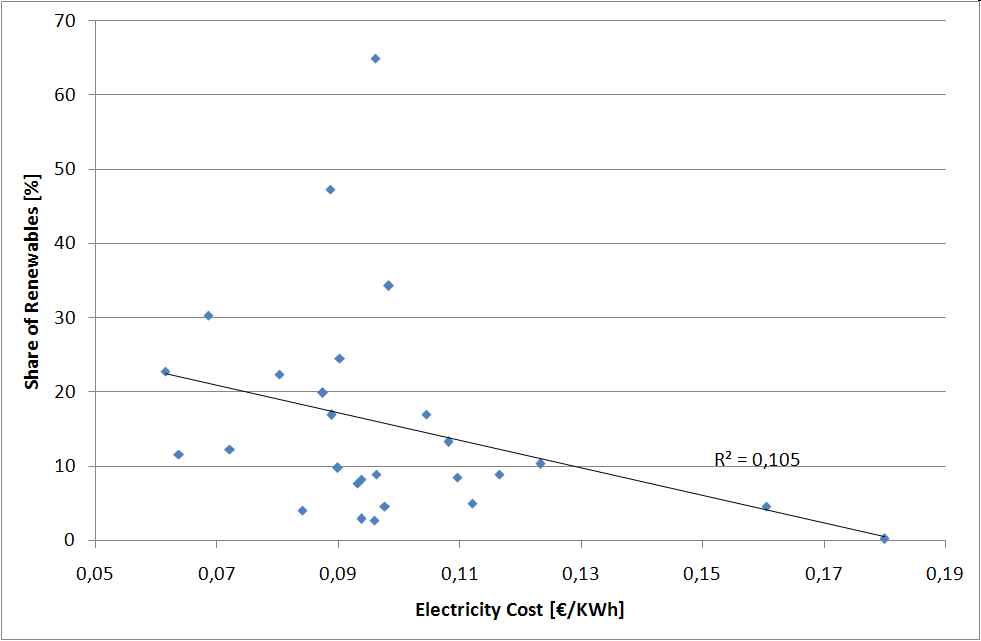
But going even further I dared to make a simple correlation graph with eurostat data. It is shown below and draws electricity costs for households and % of renewables in the generation. The result is really striking!!! The trend line is negative, the more renewables , the lower costs. Of course this is not true, first because the trend in the figure is completely unreliable, there is no trend, and second because the costs of electricity a quite complex with many subtle concepts deserving more posts.

Anyway, I think that renewables have been and still are in the first view more costly than some other sources, but in the long-term they are really profitable for the whole society. And, as a wise man told me today at work stopping all the promising renewable industry in Spain, in the verge of profitability seems a really short-term sort-view idea.