What do I think, What can I do?

I live in a 9 plant house and we are facing several maintenence/repairing operation last years due to the age of the building. With my limited knowledge I participate in a small comission to check our next project, which involves changing our wasted roof.  As we were talking with the architach about the project Y asked why we could not use a white material (or at least paint it) instaed of the greyish one we will finally use. He simply did not take the question into consideration.

Maybe he thought it was about aestetics but it was about albedo.  This strange word plays a role in our climate and can be explained with few words (although maybe not bery precisely): It is the amount of light and so, energy, from our sun that our land reflects. For that reason a quick trick to improve our situation could be to increase this and reflect more solar radiation. I know it sounds quite artificial, but we are not in a situation with too many choices and anyway we are reducing our albedo by melting several glaciers and polar snow. And its easy and in many cases costless at least in some buildings, roofs, etc… It is not the definitive solution for climate change but it could help.

Composition if 3 images from Google Maps. Left: My home city with red roofs, not very reflective. Right: An industrial area not far from the left image, the albedo is much higher. Bottom: Image from Iceland snow, real great albedo.

However, it is not commented anywhere and no goverment (local or higuer) has it included in building rules or politics. So, standard arquitetchs and building material producers will continue thinking it is about colour preference.

I would not be difficult to encourage people to love white for their houses roofs and we could counteract some tons of CO2 without terrible effort. Or at least explain its possibilities for all of us to make choices.

I am Back

It is more than one year since I started this small trial. And I wanted to celebrate this anyversary around May. However my post frequency reached a worryful minimum this spring and I stopped to write. And the more you stop the more difficult it becomes to return.
But I still have ideas I want to write, to share to some extente or maybe I just feel that this blog can help me organize some thoughts about this subject.
Because even I am not working onit, even if I do not belong to any organization close to this subject, or I am not someone to offer updated scitentific, social or politic opinion about it. I am still very worried and I read something and think about Climate Change. I still think it is a mayor challenge and should be a great priority in those economically difficult times. And finally, I feel some internal need to write again.
My intention is to write weekly. I know it is a poor frequency for a blog, but I expect it is realistic for me. Actually, this blog does not intend to be a standard blog, for the moment is more a place to write and/or organize my thoughts.

Last week spanish government is facing severe criticism for proposing a maximum speed reduction from 120 to 110 kph in speedways. The mentioned reason is to save money due to petroleum price increase due to Libian uprising. I am not going to the political issue or discussion and different aspects of the proposal or how it has been explained or decided. This kind of measure is not new (speed limit), and the opposing opinions either.

Souce: Wikipedia. Author KaterBegemot. Speed limits in Europe

What really worries me and at the same time shows some opportunities are two questions:

  1. When energy and/or petroleum become very expensive, someone is forced to save, people, the government, companies,…  If we could reflect some cost of Climate change in nowadays main energy sources cost debates would be completely different.
  2. It is not easy to reduce our power to go fast, to consume what we want, to waste resources. It is unpopular because we do not link this to a greater future improvement. We mainly see our immediate loss. This is applicable to electricity costs, flights costs, and many other things.

But the question could be understood from a different point of view. Maybe we have lived last century from energy resources accumulated during millions of years and our credit is finishing because this expenditure is too much for our climate. So we could recognize it and start changing by ourselves with conscious sacrifice, or let the atmosphere act in our society, economy and so on and be forced to change late, worse prepared and fighting each other.

Because if we want to reduce speed and gas consumption a law nor any government is not really needed.

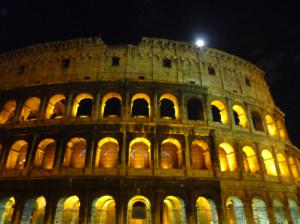
Last week I went to Düsseldorf and Cologne for a business trip. 3 days 4 flights, I know, several CO2 tons thrown to the atmosphere. This time I am not going to write about this, just some light and personal comments as I did in my recent trip to Rome .

As usually not totally white or black, first of all,  a news from Reuters about cuts in solar energy subsidies in Germany. It may seem discouraging as Germany is the biggest solar industry market (with less sun than many), but this news deserves a more detailed study beyond the scope of this post.

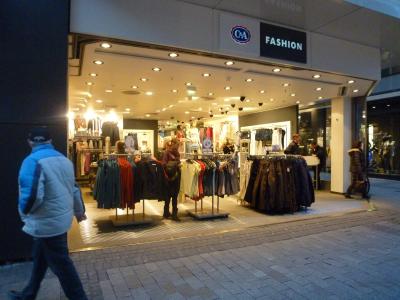
One striking photo is the next one, it was cold, not far from 0ºC, and this shop was totally open. Very attractive but very energy consuming and expensive in many senses. It would be very interesting to know our CO2 saving potential just changing this kind of evident things.


Completely open shop in Cologne centre's commertial area at ~0ºC

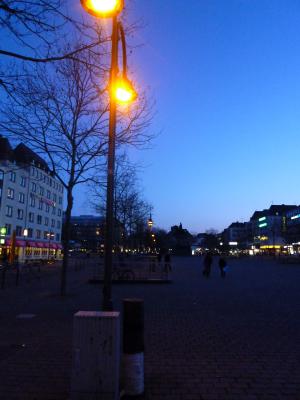
The second one is just opposite, I was really pleased to see how precise was street lights switchon time and how most of them were not too bright and directed to the floor to avoid inefficient loss in light pollution.

Street lamps

Street lamps switched on just when sunlight went out.

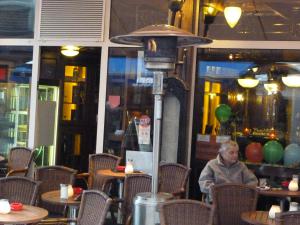
Finally one side effect of smoking ban and love for open spaces: the gas lamps in the terraces. It is growing in my home city in Bilbao too, but I saw it in central Europe before. In my personal opinion this is very similar to the open shop case, many CO2 tons thrown to the atmosphere that could easily be avoided.


Open terrace with gas burner at 0-5 ºC

Another burner at 0-5 ºC, this is more spectacular


Of course, I do not intend to criticize a country that is doing much more than most. This photos could be taken in any western country. But I usually do not take the camera when I walk in Bilbao.


It can be considered a secondary problem and certainly it is not comparable to many possible consequences of climate change as: floods, draughts, sea raising, … But, in my opinion, it is at the same time a nice and interesting symbol.

It is quite striking to realize that most prominent astronomers from XVI to XVIII centuries worked from cities. Visiting Greenwich Royal Observatory just in the outskirts of London was a real pleasure and a surprise for me.  Whereas nowadays almost everyone living in a city knows how difficult is to see any star in the night sky. In my case, the very frequently cloudy sky is another important factor too. But even for cloudless cities light pollution is a nightmare for many astronomers, and some of them are taking action against it (there are many links , those three are just a small sample: IDA, wonderful maps, Cel Fosc).  Congratulations for all of them.

Italian peninsula light pollution development, Source: http://www.lightpollution.it/

But for the moment as clearly shown in the picture we have lost hte opportunity to see the universe’s beauty. And we, urban cityzens are more than half of human population. This loss can be critizised from many point of views:

  • A phylosophycal one:the loss of perspective of the universe.
  • A scientific one: we can’t see the stars, and many amateurs find it more difficult to make contributions for general knowledge.
  • A stetical one: we are loosing a wonderful spectacle.
  • An historical one: we are getting disconnected with the night sights contemplated by our grandparents.
  • And a climate change one: We are wasting much of the light emmited by our lamps. So, we are throwing millions of tons of CO2 just to disturb astronomers, and sky lovers in general. This is an evident inefficiency and quite an interesting potential gain, we could save CO2 tons and improve this subjetive concept named quality of life.


Some time ago I saw an interesting documentary in the TV about nuclear fusion. It was very nice to see and closely related with climate change. As it uses to happen in this program  the contents were built around a pre-eminent scientist. In this case the main character was Steven Cowley. He defended convincingly the future of this technology, explained very clearly the basic ideas and some difficulties and recognised without doubt the risk of climate change.

I was a pleasure to watch this program. I only disagree in one aspect, about the solutions to climate change. Of course, Steven was convinced that Fusion was an important part of the solution of energy production for our world, he also considered important an alternative mobility (electric car or similar) and solar power. My doubts arise basically in the first one, I can not deny nuclear fusion could be a wonderful solution for universal, cheap and centralized energy. In fact it is our main energy source as the sun is fuelled in this way and the sun is the source for fossil fuels, hidropower, wind mills, solar,…

But in the same way I doubt about conventional nuclear power, I am not sure of the short or medium term possibilities of this energy source. The expected times are always 20-30 years later and the very expensive projects are fully international (very respectable and positive but also showing a poor confidence in its profitability). It would be wonderful, maybe it will be wonderful sometime, but do we have enough time? In my opinion is wiser to act with easier or closer possible ways and not thinking too much in magic solutions. Because if you buy a house based in a possible but not clear future incredible job, you can loose this big house and the possibility of a modest one.

Anyway, I support employing public money for fusion investigation, but just in case lets act as if were not successful.

I wanted to make a kind of summary of this year, the first year for this blog. It started as a trial, and I still are not sure about my energy to write periodically about climate change. But some post have been produced and some more are in drafts, so fpor the moment I do not give up.

The most direct way to make a kind of summary in this moment was to obtain new data for my climagechangemeter and show them. October was a very encouraging month with steep increments for total appearances and decrements for sceptics. But today this result is going exactly the other way: Scepticism is regaining strength and climate change loosing presence. Anyway those results are weaker than the previous gains so, global output from june is clearly positive. Is this a real index about global opinion? I am not able to say it but considering the moderate success of Cancun and some interesting results as the failure of prop 21 in California we may be getting in the right way.  The more difficult question is, are we driving at sufficient speed?


My father used to get quite disappointed and a bit surprised when the cholesterol level considered dangerous was diminished. It happened at least twice in his last years. His point of view was quite logical, if I maintain the same cholesterol it can not be fair one day and too high the next one. The question was that maybe it was dangerous all the time but we did not have enough knowledge until the key researchs were developed and accepted.

Science goes in this way, there are not scientific absolute truths to be find in mysterious papers. Only hypothesis, measurements, data, checking, discussion, more hypothesis, data , measurements,.. and finally, after some time, several papers, strong debate and frequently arguments a general consensus about one theory. Latter, this can be surpassed by new more precise measurement, more refined theory,…

The climate data

Figure from last IPCC report. In my opinion the rising curves are quite clear, what do you think?

And in climate change there is a broad consensus among climatologists. The climate is changing due to our CO2 and Methane emissions. Many other issues are not so clear, for example the extent of the effects or the way to mitigate them. But the main fact is assumed by scientific community and denying it or taking partial data or particular opinions to make everyone doubt can be effective in the short term. And even credible for non-experts like me but it is irresponsible for humans in this time and more for our grandsons.

It is possible (not very probable) that some of our actual analysis change in the future, but we have to act with what we know now, because if we wait till everybody sees it clearly it might be too late. Anyhow it will be too late for many, our choice is to mitigate it for the rest.

In the plane

As I mentioned in a previous post, I travelled by plane some days ago. It gave me an opportunity to test the “aeroplane mode” of my new small camera and to put images to some of the thoughts that came to my mind in one of the flights. It was a wonderful autumn weather over the Mediterranean sea, allowing outstanding views of sea and land.

The first sight shows one of my constant worries, a land totally defined by perfect squares for human use, are we leaving something for the rest? Is the climate change the most critical consequence of a development that forgets about limited resources and equilibrium?

But it was possible to find hopeful images too, those wind mills that are not any visual pollution in my opinion. Even moving ones generating clean energy.

And hopeless images as this thermal energy production unit (I think).

Or even mixed ones.

This is the world we live in, complex everywhere, and this is the world we want to improve or at least not worsen too much.

At the end you can say, did you really need to by a new camera having a nice but big one?

Or it was really necessary to make a plane journey? or using our recent investment in computers and fast broadband connections, a video conference would have fulfilled the same aims?

Sometimes even if I see a clear answer it is not easy to make it true, but the question remains important and could work slowly but strongly like water. The last question: do we have enough time for that?

One day in Rome

In my comeback from the long blog-summer vacations I wish to mention my last week trip to Rome. I went for a business meeting and it was a two days journey in witch only the first one was in Rome itself. It was my first time in this ancient and full-of-history city and I really enjoyed walking along the remaining of the old empire, the lively squares and the renacentist buildings. Apart from the tourist enjoyment, two questions striked my, related to climate change:

The first one was the repeated advertising about a share holding operation on Enel company, the main Italian energy company. I do not know the real meaning of the advertisement or the company but everything was very green in the ads and main picture was about a field of photovoltaic panels. Ecology and renewables are considered closely linked and if they are regarded helpful to get good image. In my opinion this is essentially a positive progress in spite of its several drawbacks (“many not very greens pretend to be very green”, interesting subject for another post). So I got quite happy for that.

In the other hand,the second issue was negative, a repeating negative one. My Italian colleagues explained my that most Romans were firm car users, they distrust public transport for not being reliable or punctual. This makes the city more chaotic and of course produces several extra CO2 tons per year. Moreover, those attitude problems are difficult to solve and require time and patience, it is very easy to enter a endless loop: I do not use public transport because it is not good, public transport is not improved because is too expensive in part because it is not used, and so on. But who should break those dynamics? Governments with convinced politics, like in the case of public debt reduction? Or convinced citizens who intend to change the mind of their policy makers?

Like the old times in which all the ways leaded to Rome, I think any way is good but we have to be fast because we may have less time than we think.