What do I think, What can I do?

In the world the CO2 emissions corresponding to the transport sector sum a 22% of the total.

Nonetheless this percentage varies seriously from country to country. Among the top emitters (next table), China and India do not reach the 10% emissions by transport, Germany and Japan are close to 18%, the USA are around 26% and some like Mexico or  Brazil are above 35%. So transport is very important depending on the location.

Transport Emissions Road Emissions
People’s Rep. of China 7.04% 5.48%
United States 30.21% 26.09%
India 9.93% 8.90%
Russian Federation 15.30% 8.85%
Japan 19.48% 17.59%
Germany 19.11% 18.51%
Korea 15.41% 14.52%
Canada 31.62% 26.02%
Islamic Rep. of Iran 23.31% 23.07%
United Kingdom 24.67% 22.90%
Saudi Arabia 23.42% 22.93%
Mexico 36.31% 35.34%
Indonesia 25.75% 22.59%
Italy 27.13% 25.58%
Brazil 42.82% 38.22%
Australia 21.44% 18.01%
France 34.56% 33.06%
South Africa 11.01% 10.23%
Poland 15.34% 14.99%
Chinese Taipei 13.12% 12.69%
Spain 36.42% 31.73%

Next histogram includes the distribution of these topo emitters but also the whole world, and in this case the panorama is even more complex with a range from less than 10% of the share until more than 90%.
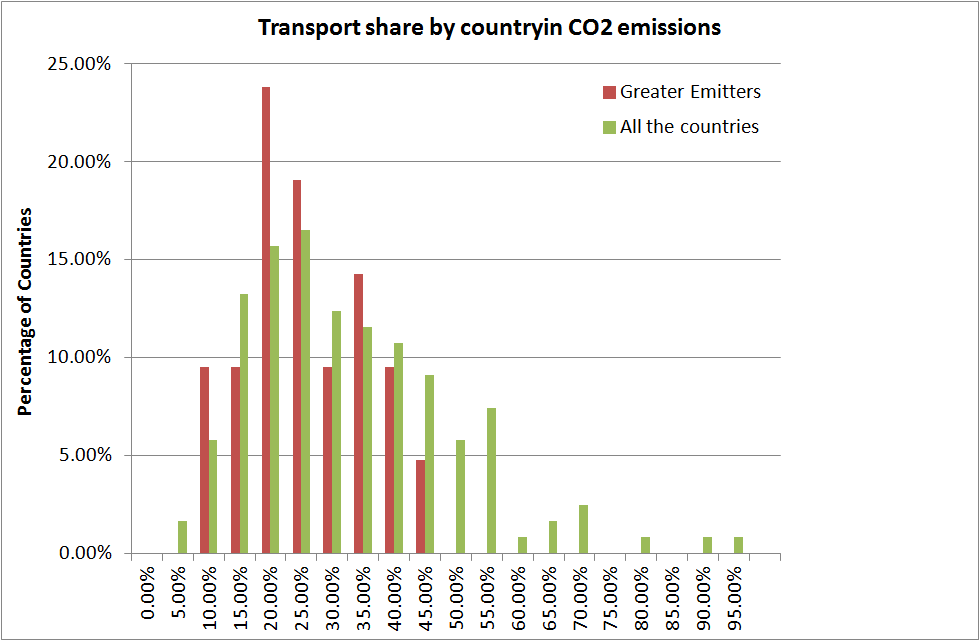
Histogram of the transport share in country CO2 emissions for two populatios: All the world and the top 20 emitters, source of data IEA

Histogram of the transport share in country CO2 emissions for two populatios: All the world and the top 20 emitters, source of data IEA

Anyway, one thing is quite regular for all of them road is the main transport emission source, a 16% around the world but up to 80% in Congo or 35% in Mexico.

Meanwhile, americans are driving less, (reducing that 26%) some also talk about peak car thereOne thing is clear, if we want to mitigate climate change, we will have to drive less (mas transit, bicycle, or just walk), do it more efficiently or change cars technology or all at the same time. In some cases it is not difficult to start saving CO2.

Ice Age

Ice Age in the North Hemisphere, image from http://www.sciencemuseum.org.uk/ClimateChanging/

In a recent study CO2 appears our particular hero against the next ice-age. The study is really about the peatlands capacity to sink carbon and its influence in last glacial periods, but it have been used to weaken climate change concept.  In fact, coming ice-age is a repeated subject in skeptic blogosphere, for example here .

I am not able to judge the scientific value of the study, or have not check where it has been published, this is not the question of this post, it can be really prominent scientific work, while explained this way it is like being in a flood and thanking the river for the water that quenches one’s thirst.  The study recognizes the role of CO2 in planet climate, the peatlands are carbon sinks and in absence of human actions a new ice age would come in some moment, so, conceptually, it is not skeptic at all, but it lacks a simple sentence explaining that we are currently far from a new ice age.  Actually, if we burnt all these fossil fuel for that purpose we are done and we can stop for now. And here comes an interesting question for me (not really related to the paper):

If we had known beforehand that sending to the atmosphere all those gigatons of CO2 we would stop next ice age, would this giant transformation be OK ethically?

I am not sure, my first simple and emotional answer is a yes with many doubts.

Unfortunately we didn’t know all this 50-100 years ago so the only possible question now is: Should we stop sending tons of CO2 before going to an barbecue-age?

This answer is much easier: Yes and without delay.

This way we can even allow a future question: Should we save some fossil fuels for allowing future generations to allow controlled emission patterns to avoid future ice ages?

Certainly, I do not know what will say the grandsons of my grandsons of my grandsons. It is easier to imagine the opinions of our grandchildren: Stop and leave at least two-thirds of fossil fuels in the ground and we will think the best way to use them in the future.


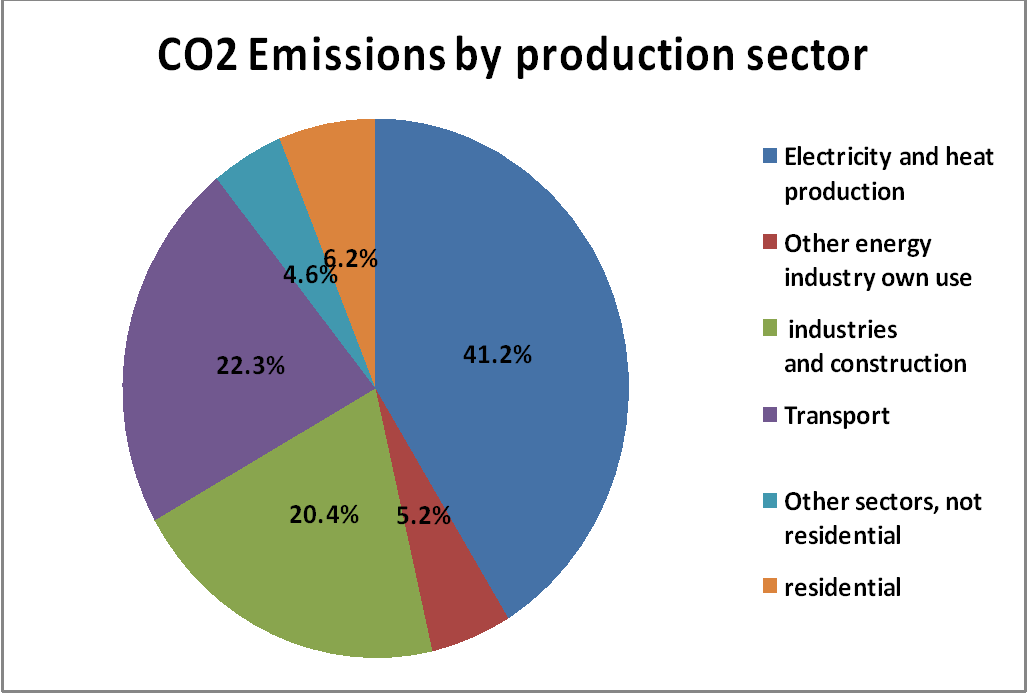
CO2 Emission percentaje by production sector in the world, source of data IEA.

CO2 Emission percentage by production sector in the world, source of data IEA.

I frequently think that the climate change solution is in transforming the power production sector and consumers mentality somehow. However, many times remember too that transportation is important and I got in mind the simple figure that one out of three CO2 tons comes from transport. Rough numbers help but it is always better to be more precise, and the two figures in this blog follow this purpose. They have been obtained with the open data from the Internationa Egergy Agency (IEA) and show total emissions in 2010.

The first one, at the beginning, displays the emission proportions by emission production sectors. In some cases, these divisions are not easy to understand but the main conclusion can be that electricity production is responsible for more than 40% of emissions and this is good news in my opinion because the progress in low-carbon electricity production has been much fester than in other factors and because in fact there are many countries producing most of their electricity without fossil fuels. Transport and industry account for other more or less 20% each (in industry excluding electricity use). Transport is a bit lower that the 33% that I expected and it is mainly road transport. Residential sector is surprisingly low.

CO2 Emission percentaje by consuming sector in the world, source of data IEA.

CO2 Emission percentaje by consuming sector in the world, source of data IEA.

In the other hand, the last figure classifies the same data by consuming sector. So roughly, industry is the objects we use, transport is transport and residential our houses. In this case, industry leads the figure with 36%, and transport and residential follow close to 20%.

The main reference is that we should reach 10-20% of current emissions to be on the safe side, so we have to make important effort in all areas.

One week vegatables, or just

Vegetables for the week, or just “the bag”, Image from Wikipedia

2 months ago I wrote about a personal/familiar experience I was happy about, now I know how it is called in english: Community-Supported Agriculture. To write in English is many times a challenge for me.

I learnt the term from this post that explains the concept better than me. This is the kind of small great things that can really make a difference for the two great objectives of climate change:


  • Mitigation: The reduction of transport requirement will certainly help, as transport is roughly the source of one-third of CO2 emissions. But even more, local production can make better choices regarding land usage, another 10% of emissions
  • Adaptation: Some of the most terrible consequences of climate change in a world approaching 10 billion will be the pressure in food production and distribution: another word; food security. Making it profitable to produce near home will be a warranty of some food production, and, even more, a comprehensive supply chain will avoid disagreeable surprises from markets we do not understand.

Of course, I do not think this is the ultimate solution for climate change nor the only possible source of food for me or anyone close to me, it’s just a good idea, reasonable, and helps and works.

ice cubes

ice cubes

This final part of the year is always an opportunity for making a balance.

In my opinion the balance is clearly negative as we are still sending not only too much CO2 to the atmosphere, we are sending more than ever. And this is the important part, because any possible improvement will not be effective until it gets a real effect on emissions.

The annual meeting in Doha, COP18, were not a significant step forward, and in spite of alleviating Obama’s victory and strong commitments in renewable energy as in Germany, the global emission path is still upwards with the driving force of emerging economic powers, mainly China.

In the other hand renewables are growing in many places and electric cars are not just in the labs.

I do not think the skeptics are winning the concept battle, I think there is more and more people convinced about climate change in most places of the world, the problem is that much more action is needed and fast. Maybe the two main topics this year have been the record low ice surface in the Artic and extreme weather events as Sandy hurricane, just in time to show american skeptics what is coming next. They are important because one is very visual (my cousin, not involved in those issues, told me se was impressed by the ice surface record), and the other very important for our everyday life.

I have not written about those two subjects for lack of time, as with many other posts I have in the waiting list, so my personal balance is that I have not written about many interesting issues I should but at the same time I am happy for writing more than previous two years, arriving to 100 posts, and above all, I have learnt a lot and I still want to write posts about climate change although I doubt about the approach or style.

So, happy new year and let’s hope we, the world, will go a step forward in 2013. Because we can and we must.


Bangladesh location in the earth from Wikipedia

Bangladesh location in the earth from Wikipedia

The installation of solar panels to electrify 1 million houses in Bangladesh is in my opinion great news, not just for the KWh produced for those people by clean means reducing some CO2 tons.

It also means that for poor people off-grid solar energy makes more sense than whole big investment in new grid systems fed by fossil fuels with uncertain costs in the future.

Al also means that the technology developed in rich countries (and not so rich ones) after a fossil fuel based 200 year industrialisation maybe effectively used to start using low-carbon electricity in places that have not known it before.

Symbolically means that it is possible to start improving every day  life conditions based on solar energy of small-scale without going the fossil way from the beginning, becoming rich and after that reducing emissions.

And finally, it means that for many people living with almost nothing in many places, they can dream of improving their living standards without spoiling the climate of their grandchildren.

Chevrolet Volt Image from Wikipedia

Chevrolet Volt Image from Wikipedia

A recent article  in a general media mentioned the virtues of Chevrolet Volt, Open Ampera in the european version. Its numbers are astonishing as combines the comfort and autonomy of a Hybird car (or a fuel driven one) with the big batteries of many electric ones. The result can be a very low fuel expense of 1-2 lt per 100 Km. And the amazing thing, at least for me, is that it is not just a car in the exhibitions, it is in the streets and anyone can buy it, if you can afford to. It is more real than I expected.

No doubt,  this is another step forward, as it was my beloved Prius. Regrettably it is still too expensive, (twice the standard Prius), still far from the possibilities of most. I hope it will be getting more and more affordable, our future and a third  part of global CO2 emissions depend on transportation. So we need several kind of approaches to improve in this area and we need them fast.

COP18 talks in Doha are over and once again the results are at least unclear. Most blogs offer more rigorous analyses but they agree in the poorness of the result. Climate Progress is critical with the result, as InsideClimateNews the NYtimes is only slightly more optimistic and the skeptics are celebrating the result, so they coincide in the analysis.

Kioto protocol has been prolonged but only involving countries accounting 15% of the CO2 emissions, there are some other promising results but not very clear. So, once again, everybody agrees about the magnitude of the problem (otherwise they would not meet every year) but few countries want to be legally bounded to a worldwide treaty. This approach is not working for the moment, however, it is not the only way.

Not being legally bounded does not mean that many countries are not going to act in some way and there are many other possible agents that can get significant results as subcountry entities (California is far more advanced that the USA for example), Cities-Towns, activist groups, Households and finally families and individuals. Nevertheless, a clear international agreement would be the definitive push for every other action for this uniquely global problem, next year we will see again.

Qatar Coat of Arms, source: Wikipedia

Qatar Coat of Arms, source: Wikipedia

COP18 conference held in Qatar has produced at least a first beneficial output. The government has announced an important investment to produce 1800 MW by solar power out of a total electricity capacity of 7000 MW. Even better, they will encourage particulars to produce electricity at home by small solar panels with a feed-in-tarif.

As they explained, the official reason to such a political impulse in one of the mayor producers of liquefied gas is the reduction of cost and the abundance of sun in their home. Good reasons, I suppose that holding the COP18 being the biggest emitter (mentioned in many blogs) is another one.

I hope it will become true, because we need the commitment of everyone in this big challenge of climate change, and the competitions to avoid last places in this shameful classification could help.

COP 18 is the 18th international meeting to address the climate change problem. It is held in Doha . I listened the news in the radio this morning with quite a clear summary of the challenges involved and by the way a good explanation of climate change causes, encouraging but an exception, I would bet that most of my friends, family, coworkers have not heard about it.

This meetings should be very important as climate change problem requires global solutions to be shared by most countries. However,  the previous meetings have been at least partially frustrating as the advance is slow and the discussions are more predominant than the agreements. The figure below shows that the world emission path has continued to go upwards in spite of 17 COP meetings, so reached agreements are clearly insufficient. But we, the humans, need time to get agreements, the problem is that we are running out of the time to get a reasonable agreement for a reasonable future climate.

Graph showing CO2 emission path last years

Graph showing CO2 emission path last years, data from IEA

Media could play an important role to make those meetings more efficient and to help people know what is discussed there and how all of us are affected. A convinced world population could be a great force to seriously start climate change mitigation instead of adaptation.

By the way, the guest country Qatar is ranked 1st in per capita emissions in spite of their last year reductions (last figure). The comparison with USA, Germany, Japan or China (4 out of 5 economic powers in the world) is quite significant. If all of us would be emitting so much CO2 (I do not think it is possible) we would live  in an oven.

CO2 per capita emissions for 5 countries including Qatar (source of data CDIAC)